
Month: June 2017

REVIEW: Is “Despicable Me 3” family-friendly?


There’s a reason that the quirky man we call “Gru” is our favorite villain-turned-hero. He’s funny. He’s clever. And if you watch him long enough, you’ll discover he has a big heart, too.

But despite having three beautiful young daughters and a lovely wife, things aren’t going so well for our world-saving crusader.

That’s because there’s a new villain in town who keeps getting the best of Gru. His name is Balthazar Bratt, a washed-up actor-turned-bad guy who headed the No. 1 TV show (“Evil Bratt”) for three glorious years in the 1980s and then fell out of the spotlight once it was canceled. Today, he spends his time listening to 80s music, wearing 80s clothes, and stealing anything that will keep his name on the front page of the newspaper. And he stores it all in his Rubik’s Cube mansion in the sky.

Despicable Me 3 (PG) opens this weekend, continuing the saga of Gru (Steve Carell), his wife Lucy (Kristen Wiig), their three daughters, and, of course, the love-them-or-hate-them Minions.

The plot turns when Gru fails to nab Bratt (Trey Parker) during a theft of the world’s biggest diamond, which leads to the firing of Gru and Lucy in their roles at the Anti-Villain League. Searching for a job and for his purpose in life, Gru heads across the globe to meet his newly discovered twin brother Dru (Carrell), a rich underachiever who reveals that their father was a famous villain: “The Bald Terror.” Dru wants Gru to return to his old ways.

“Face it … villainy is in your blood,” Dru tells him.

What will Gru do?

Warning: spoilers ahead!

Violence/Disturbing Images

Moderate. Although it’s mostly the slapstick for-laughs variety. Bratt performs karate and kicks several people. Gru and a villain punch one another. Bratt lands darts on peoples’ foreheads. Gru tricks a visitor to his house into crashing a rocket in the adjacent neighborhood (the man is injured, but fine). Gru shoots missiles at a villain. Bratt, sitting inside a building-size creation of himself, destroys parts of a city.   

Sexuality/Sensuality/Nudity

Minimal. We see a beach scene, with bikinis and some cleavage. Gru’s clothes are blown off (the scene is quick and everything except his bottom is covered). Seconds later, he is hanging from a giant bubble gum bubble, with a wedgie. We hear a comment about a girl “looking hot.” The Minions, while celebrating something, strip to their underwear and rub their bottoms. A pig pokes at Gru, who responds, “That’s my private part.” One of the Minions, in jail, exposes his bottom to get a tattoo. Some of Bratt’s dances throughout the movie are borderline risqué, including one scene in which he gyrates his hips while sitting on a workout ball. (Note: A scene from the trailer, in which Gru’s mom slaps a muscle man’s buttocks, is not in the movie.)   

Coarse Language

None, other than a jeesh, a “son of a” that doesn’t include a curse word, and a heck.  

Christian Images/Dialogue

Agnes prays in her bed for help finding a unicorn.

Life Lessons

Animated movies typically fall into one of two categories: 1) funny with a point, 2) funny without a point. Thankfully, Despicable 3 falls into the former category, and it carries several life lessons for families.

First, Gru faces a major temptation to return to his old way of life—the life that seemingly comes natural for him. Second, he encounters peer pressure from his brother and family to uphold the family tradition of villainy. Third, Gru consistently puts his three daughters and his wife first—prioritizing them in a way rarely seen in the real world, much less in animated films. Look hard, and there even are lessons on jealously and workaholic-ism.      

Worldview

God isn’t mentioned in Despicable Me 3, but the film nevertheless is set in a world where good triumphs over evil and the traditional family is celebrated. Gru and Lucy are (mostly) fine examples of a loving father and mother.   

Family-Friendly?

It’s difficult to find an animated movie that doesn’t have scatological humor. This one even boasts a flatulence joke before the movie starts (thanks to the Minions). Still, the low-brow humor doesn’t dominate the film, and the story’s positive traits—and wonderful ending—made me glad I took my 9-year-old son. It is mostly family-friendly.    

Movie Partners

McDonald’s and Kellogg’s are two of the leading companies partnering with Despicable Me 3.

Thumbs Up … Or Down?

I was skeptical about Despicable Me 3. Were we getting another film where the bad guys are being cheered? The answer: no, at least not if you wait until the end. 

Illumination Entertainment and Universal Pictures know how to pull parents into a film, especially ones, like me, who grew up in the 1980s. The formula goes like this: Play lots of 80s songs. Show lots of 80s fads. And have a goofy character (Bratt) portraying all of it. I laughed a lot in Despicable Me 3. Thumbs up.

Discussion Questions

1. Describe a time in your life when you faced peer pressure or had to choose between good and evil.

2. List a few tips for avoiding/resisting temptation and peer pressure.

3. Why do you think Gru – despite his evil past – loves his three daughters so much?

4. What were Gru’s motives during the last half of the film? Did they change as the movie progressed?

Entertainment rating: 4 out of 5 stars. Family-friendly rating: 3.5 out of 5.

Despicable Me 3 is rated PG for action and rude humor.
SBTC launches Women”s Prayer Network

Grapevine “Women are going to get together, but when we get together we should really be talking to God,” said Camille Minor, who was recently named head of the new SBTC Women’s Prayer Network. 

The idea for the initiative was birthed from a desire by prayer strategist Ted Elmore to capitalize on and expand a culture of prayer that he said has always existed among women in the church. 

“The women in the churches, historically, currently, are some of the greatest people of prayer in our churches,” Elmore said. “They are the prayer warriors in the home. They are the prayer warriors in the church. They are the ones that are behind the scenes. We need to cooperate with what God is already doing.” 

The ministry will connect groups of women from churches throughout the state and encourage them to meet together regularly to pray. 

Minor, whose husband is pastor of Anderson Mill Baptist Church in Austin, said she has been privileged throughout her life to learn from the examples of many faithful women who have devoted themselves to prayer. Her hope is to see more and more women connecting over this shared desire to turn to Jesus.

“Even though there may be turmoil in our family, our church, or our nation, the Bible says in Luke 18:1 that Jesus told a parable to show that in all times they ought to pray and not lose heart,” Minor said. “As women, we’re not to give up or turn to other things for comfort; we’re to persevere in prayer.”

The Women’s Prayer Network will focus on praying for the home, the church, pastors, non-believers and the nation. 

“I want there to be a river of prayer all over Texas, where women are getting together in groups and praying. Maybe it’s once a month, maybe more often.”

Aside from fostering deeper relationships with the Lord, Minor also believes the network will break down walls and barriers between women in the church. 

“What I’ve seen in my own life is that meeting with other women to pray has been the one thing that has caused unity,” she said. “We may not agree with everything, but when you get together and you’re praying in the name of Jesus together, there’s a unity and a joy that you can’t really explain any other way.”

For more information on the Women’s Prayer Network, visit sbtexas.com/prayer

Grieving wife, children grateful for care and support following pastor”s death

Waco Over the last year, Courtney McCash has walked through the pain of losing a spouse, but in the midst of her suffering, she has also experienced the love and encouragement of churches across the state. 

In April, her husband, Jason McCash, passed away, following a 14-month battle with cancer. A former chaplain in the U.S. Army, Jason had served as pastor of Timber Crest Baptist Church in Waco since 2014. 

During his final months, the McCash family’s time was consumed with medical appointments and hospital stays, as Jason’s health declined. 

“There was a lot of back and forth to doctors appointments and tests and wondering what’s going on,” Courtney recalls.

During this difficult season, Jason, Courtney and the couple’s two children found support not only from friends, loved ones, and their local church, but also from the Southern Baptists of Texas Convention. 

Throughout Jason’s illness, Gilbert Chavez, the field ministry strategist serving churches in that area of the state, faithfully walked alongside the McCash family, making visits to their home and offering constant prayer and encouragement. 

“It’s always nice to know that someone is praying for you, especially with Gilbert. You just know if he says he is praying, then he is. We could feel the prayers being lifted up, and that means a lot,” Courtney said.

After Jason’s passing, Chavez and the state convention remained valuable resources for the McCashes, contributing to emergency funds that enabled Courtney to entirely cover the cost of funeral arrangements.

“That was amazing,” she said. “I’ve heard so many stories of people that have to pay a fortune and are in debt because of a funeral, and I would hate to have had that. Thankfully, that (financial support) helped us to be able to go in and pay it and not have to worry about it.”  

Through the help of Chavez and other SBTC personnel, Courtney also learned that she was eligible to receive death benefits through GuideStone Financial Resources, which partners with the convention’s Pastor/Church Relations department.

Over the last three years, this ministry has provided $85,000 to families of SBTC pastors, like the McCashes, during times of need. 

“The money we received from GuideStone (is) going to allow us to buy a home,” Courtney said. “We’ve lived in parsonages for the last six years, … and I didn’t know what we were going to do. That’s going to allow us to be able to buy a home and not have to worry about finances at this point in time.”

Because of these benefits, Courtney said she won’t have to go back to work full-time, giving her the opportunity to be with her children as they continue through the grieving and healing process together.  

“That has alleviated a lot of pressure,” she said. 

Chavez said being able to come alongside Courtney in behalf of the SBTC during the last year has been an honor.

“It was a blessing to me to know that we were able to intervene and provide the encouragement of knowing that people are standing with her and beside her to support her and her family,” he said.

The love and support have not gone unnoticed, Courtney said. 

“It’s been great to have people that you know really care, that go out of their way, even though they’re not in the same city or area; they care and follow up with you and make sure that everything is ok.”  

The Single Greatest Crisis of Our Day

What would you say is the greatest crisis that we face in the world?

Poverty?

Hunger?

Terrorism?

Racism?

Religious Liberty?

Actually, the single greatest crisis of our day is that there are human beings who are not Christians. The crisis is so great, in fact, that there are actually entire people groups that still have not heard the gospel one single time.

This is by far the single greatest crisis of our day. Let me be clear about what I mean. It is of far greater consequence for one person to be saved than for all of Africa to be cured of its AIDS epidemic. It is of far greater consequence for one person to be saved than the cure for all cancers to be found. It is of far greater consequence for one person to be saved than for homelessness or world hunger to be solved. Lostness is a far greater crisis than racial brokenness, the displaced refugee crisis, terrorism, millions of babies being aborted, human trafficking, and orphans in need of adoption.

If someone dies in their lost state, they burn in hell forever. “For the wages of sin is [eternal] death …” (Romans 6:23)

Recently, a friend went to the ER with an intolerable headache and discovered he has a brain tumor. Now, let’s be clear, the headache was intolerable. So much so, surgeons performed emergency surgery in which they cut open his skull and drained fluid to provide relief in order that he could live with any quality of life. The headache was a major problem that needed significant attention. But, nonetheless, the headache was a symptom of the tumor. At all times, the doctors and my friend have been clear that the greater crisis at hand is the tumor.

As we see many symptoms of brokenness in our culture today, let’s not lose sight of the root cause. Social injustices are the intolerable headache; lostness is the tumor. One is a serious symptom; the other is the heart of the problem.

I have led my church to be involved in social justice issues including sanctity of human life, religious liberty, refugee ministry, immigration ministry, orphan care, hunger and more. And I am really proud of my members who are personally involved in these ministries. Out of our love and allegiance to Christ, we love our neighbors as we love ourselves; all of the law and the prophets hang on these two commandments.

But none of this changes the fact that the single greatest need of our culture is evangelism and missions. Yes, we still address the symptoms of lostness in our culture, but our priority must be the heart of the problem—lostness.

As leaders of churches, we must regularly clarify in the minds of our people the symptoms of brokenness from the root cause, lest they become confused. Though we lead our churches to help provide culture with relief from social injustices, above all else let us prioritize and emphasize the actual sharing of the Good News with unbelievers.

REVIEW: Is “Transformers: The Last Knight” OK for kids and teens?


Has anyone seen Optimus Prime? That’s what General Morshower—and every other good guy on Earth—wants to know.

The last time we saw our hero, Prime was drifting through outer space, toward his home planet of Cybertron, searching for his creator.

That’s too bad, because we sure could use him.

Our home planet is a wasteland. Transformers have been banned, and a government-backed para-military unit, the Transformers Reaction Force (T.R.F.), is searching the city streets with orders to destroy all “robots in disguise.” The good Transformers (Autobots) are hiding out in Cuba and South Dakota, while most of the bad ones (Deceptions) are in jail.

So, who’s going to save us from that giant alien planet careening toward earth? Scientists tell us it will kill tens of millions of people and likely end civilization as we know it. If only we could find Optimus Prime.   

Transformers: The Last Knight (PG-13) is now in theaters, giving us the fifth live-action film in the series based on the 1980s toy line. It is directed by Michael Bay and stars Mark Wahlberg as Cade Yeager, who is assisting the Autobots hiding out in South Dakota; Laura Haddock as Viviane Wembly, a professor and Yeager’s love interest; and Anthony Hopkins as Sir Edmund Burton, who is the keeper of the Transformers’ history on Earth.

This newest Transformers film delivers the cool CGI and battle scenes that have made the series so popular. Unfortunately, it also tosses us a confusing and head-spinning plot. The movie opens with a Dark Ages battle in A.D. 400, where we learn that a Transformer gave Merlin a magical staff that helped deliver a battlefield victory. It then jumps to the present day, where Yeager eventually is given a “metallic talisman”—a large alien-looking coin—that carries some significance to the planet Cybertron. Then, everyone chases the staff and the coin thing for the rest of the film, and we’re left wondering … why? And in the middle of all that, the Nazis make an appearance.

Warning: minor spoilers!

Violence/Disturbing Images

Excessive. Transformer films, of course, are known for their sci-fi violence, and The Last Knight is no exception. The robots punch, kick and shoot in scene after scene. They use swords. They use machine guns. They use laser guns. (Even when the robots are destroyed, they sometimes magically reattach.) The opening scene with a Dark Ages battle provides a different type of fighting, with more blood than is typical of a Transformers battle. We even see soldiers, on fire, running around the battlefield. The body count in The Last Knight is quite high.  

Sexuality/Sensuality

Moderate. Vivian’s family, wanting her to marry, jokes about how they want her to meet a man “or woman.” One of them then looks in the classifieds for “women seeking women.” Vivian displays cleavage in a dress and a shirt. When Yeager calls it a “stripper dress,” she says, “If my dress makes you uncomfortable, maybe I should take it off.” Later, she and Yeager talk about how long it’s been since he’s had “whoopee.” When the two of them ransack an upstairs room looking for an historical item, her family downstairs thinks the noises are from something else. Finally, when the metallic talisman crawls down his pants, she suggests they could find out what happened to it. They kiss in the movie’s final scenes.  

Coarse Language

Excessive. I counted about 80 coarse words: sh– (31), a– (13), he– (12), bi–h (9), misuse of “God” (8), da– (4), d–k (2), misuse of “Christ” (1), p-ss (1). Sadly, the movie also shows kids, presumably in junior high, cursing, too.

Life Lessons

Yeager gives us lessons on regret and redemption with his young adult daughter, who he hasn’t spoken to in years. “It looks like to me you’re running out of tomorrows with your daughter,” one of the characters in the film tells him. His daughter leaves voicemails, telling him she loves him; he can’t talk to her for fear of being tracked. Later in the film, he tries to make things right.

There also are lessons on friendship, courage and teamwork.   

Worldview

It’s a science-fiction universe without the God of the Bible. Optimus Prime finds his creator, a goddess named Quintessa, who demands his obedience (even though they fight). She calls herself the “prime of life.” It’s worth noting that Optimus Prime wants to find out who made him. It seems such natural urges aren’t confided to humans.  

Family-Friendly?

It’s always frustrating when Hollywood takes a kid-friendly idea—say, robotic toys—and turns it into an adult-centric movie. Parents are then left trying to explain to little Billy why he can’t go watch Optimus Prime.

It’s difficult to overlook the language in this one, even if we give it a pass for the mostly bloodless sci-fi violence. It’s not family-friendly.

Thumbs Up … Or Down?

I’m a guy who enjoys action movies with battles, chases and explosions. But it’s best to have an enjoyable plot, too. I really wanted to like this one. It’s simply too confusing and too long. Thumbs down.  

Discussion Questions

1. The movie tells us that “magic does exist.” Does it? What does Scripture say?

2. What did you think of Optimus Prime’s actions during the final scenes?

3. The narrator tells us: “We can be heroes if we only have courage to try.” Is that true?

Entertainment rating: 2.5 out of 5 stars. Family-friendly rating: 2 out of 5 stars.

“Transformers: The Last Knight” is rated PG-13 for violence and intense sequences of sci-fi action, language and some innuendo. 

Look Like Heaven: Language differences strengthen ministry of merged churches

LUFKIN For about six years two Lufkin churches have met in the same building—two independent congregations, two different languages but each working toward the same goal. Their kingdom work brought them together for mission trips and local ministries, and instead of letting their language differences act as a barrier, they realized what bound them together was greater than what separated them. 

Eventually, the two churches who shared the use of one building and ministry work in their community decided to become one congregation. Practically speaking, forming one church made sense. Spiritually speaking, they realized it could make all the difference in the world for the people of Angelina County.

“There is no more ‘us’ and ‘them’—what a picture of heaven [this] will be,” Randy Brown, pastor of Southside Baptist Church in Lufkin said during the May 7 service celebrating the uniting of Templo Bautista Jesús es El Señor with Southside. “After today, we will truly be one staff working for the kingdom.”

With the use of a translator, Brown and Ricardo Coss, pastor of the Spanish-language congregation, told the joint congregation that their work together as “One church, Two Languages” will be a witness to the people in their community. 

“This is the Lord’s will to unite the people in church,” Coss told the congregation. “It does not matter the ethnic group or skin color.”

Six years ago, following a change of church leadership at their former meeting location, the Spanish-language congregation of 20-30 people was asked to find a new place to worship. Southside welcomed the congregation to use their facilities.

In 2014 and 2015 the pastors of both congregations left for new ministry opportunities, and Coss and Brown took the leadership roles at their respective churches, keeping the existing partnership in place.

Moving beyond sharing a building to becoming a single congregation soon became an issue to address, and both pastors entered the new relationship with hope and a healthy sense of the growing pains that may result.

“One of the biggest problems is the breakdown in language and culture,” Brown told the TEXAN. “I also believe that there will be a little bit of struggle with working within the church structure of getting things done in an orderly manner.”

Mike Gonzalez, Southern Baptist of Texas Convention director of Hispanic Ministries, who assisted with the transition, said churches are increasingly choosing to merge instead of simply share space. Traditionally a fledgling Spanish-language church would rent church space from a larger English-language (Anglo) congregation. Gonzalez called that the “two churches, one location model.”

Additional models included the Anglo church planting a Spanish-language “mission” church or creating a Spanish-language “department” within the church.

Coss and Brown recognized more things tied the two churches than separated them.

“To be honest most of our people already thought that we were one [church],” Brown told the TEXAN.

That unity was most evident among the children and youth, Gonzalez said. Many of the children attend the same schools and speak English, often acting as a bridge between the Spanish and English-speaking members.

The pastors recognized the confluence of circumstances that made a merger of the two congregations inevitable—and welcome. Brown noted the three-fold growth of the Templo Bautista Jesús es El Señor under Coss. And Coss knew that growth required organization as a church body.

After seeking counsel from SBTC Hispanic Ministries staff, the two congregations decided the One Church, Two Languages model would best serve the needs of both congregations and their community. They realize they have begun a journey that will have difficulties, but Coss said that is to be expected and will not overshadow the work God has for the new church, which will retain the name Southside Baptist Church.

“The church is like a lab from God,” Coss told the congregation. “Here is where we learn to live together, to forgive each other, and to accept each other. That’s the Lord’s will.”

Brown said their efforts are already bearing fruit.

“I can’t tell you how many people who have asked me to share what is going on,” Brown said. “Our country is so divided now; it’s time for the church to tear down the barriers that divide us. As we seek to be a multi-ethnic church, it bears witness to our community that Jesus and his commands are real in our lives.”

The month of July has been set aside as the statewide emphasis for the Look Like Heaven initiative, which is designed to encourage cross-cultural interchange among SBTC churches. For more information, visit sbtexas.com/looklikeheaven.

SBC messengers approve resolutions related to “alt-right,” Planned Parenthood, prayer, substitutionary atonement, etc.


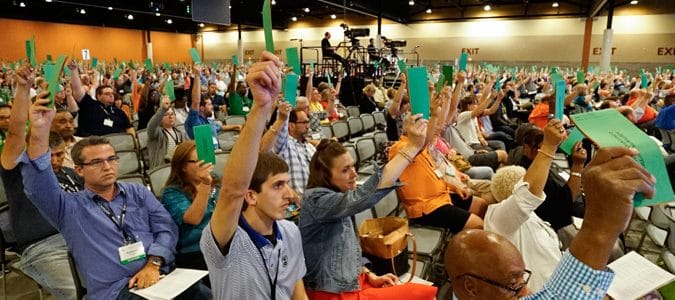
PHOENIX—Messengers to the 2017 Southern Baptist Convention annual meeting denounced “alt-right white supremacy” in a nearly unanimous vote Wednesday, June 14, after a tumultuous 24 hours following the failure Tuesday of the resolutions committee and messengers to bring an “alt-right” resolution to the floor.

It appeared maybe fewer than 10 messengers in the Phoenix Convention Center hall voted in the afternoon session against a resolution on “the anti-gospel of alt-right white supremacy.” The “alt-right,” a movement that advocates white nationalism, has gained increasing attention in the last 18 months.

<>


In the resolution, messengers said they:

— “[D]ecry every form of racism, including alt-right white supremacy, as antithetical to the gospel of Jesus Christ;

— “[D]enounce and repudiate white supremacy and every form of racial and ethnic hatred as a scheme of the devil intended to bring suffering and division to our society;

— “[A]cknowledge that we still must make progress in rooting out any remaining forms of intentional or unintentional racism in our midst;

— “[E]arnestly pray, both for those who advocate racist ideologies and those who are thereby deceived, that they may see their error through the light of the gospel, repent of these hatreds, and come to know the peace and love of Christ through redeemed fellowship in the kingdom of God, which is established from every nation, tribe, people, and language.”

After the vote, most messengers stood to applaud the result.

Dwight McKissic, the African-American pastor who submitted the original resolution, expressed gratitude for approval of the final version.

“I’m grateful that things have ended up like they have, I think, for the kingdom of God’s sake,” McKissic told reporters after the vote. “I think we’re back to a good place after a 24-hour roller coaster ride.”

The pastor of Cornerstone Baptist Church in Arlington, Texas, said he was “very pleased” that the final resolution —which was markedly different from his version—addressed the “alt-right” and white supremacy. “I think we’re unified around that,” he said.

The fact it took nearly 24 hours to pass such a resolution clearly disturbed McKissic; however, he was encouraged “to see so many Southern Baptists take a courageous stand” and for a generation of them to say, “We will not take this sitting down,” McKissic said.

Southern Baptist ethics leader Russell Moore, who spoke in support of the resolution from the floor, said of the resolution’s passage, “Southern Baptists were right to speak clearly and definitely that ‘alt-right’ white nationalism is not just a sociological movement but a work of the devil.

“Racism and white supremacy are not merely social issues,” said Moore, president of the Ethics & Religious Liberty Commission. “Racism and white supremacy attack the gospel itself and the person of our Lord Jesus Christ.”

In bringing the resolution to messengers Wednesday, Resolutions Committee Chairman Barrett Duke apologized to the convention on behalf of the panel.

“We regret and apologize for the pain and the confusion that we created for you and a watching world when we decided not to report out a resolution on alt-right racism,” he said. “Please know it wasn’t because we don’t share your abhorrence of racism and especially, particularly the vicious form of racism that has manifested itself in the alt-right movement. We do share your abhorrence.”

The torturous path the resolution took to passage began Tuesday afternoon when the Resolutions Committee offered nine resolutions—all that gained unanimous or nearly unanimous approval—but did not report out a resolution on the “alt-right” from McKissic.

In explaining Tuesday afternoon why the committee did not report out McKissic’s resolution, Duke told reporters the committee agreed with the resolution’s point on racism but thought it and other “elements [in the proposal] already had been addressed recently” in Southern Baptist life.

At the close of the committee’s report, McKissic sought to bring his resolution to the floor for a vote. He asked that the SBC “would go on record to abate darkness that’s invading our nation right now.” Many “alt-right” members claim to be Southern Baptists, he said.

His motion failed to gain the two-thirds majority required in a raised ballot vote. In the evening session, a similar motion from the floor fell short again, gathering only 58 percent in a vote taken by marked ballot.

The Resolutions Committee asked Tuesday evening for an opportunity to bring such a resolution to the convention Wednesday, and the Committee on Order of Business and messengers approved its request. The Resolutions Committee worked on a final version into the earlier hours Wednesday morning, Duke said.

SBC President Steve Gaines spoke to messengers late Tuesday night before they voted on bringing an “alt-right” resolution to the floor.

“I want to encourage you: Let’s make sure before we leave Phoenix everyone knows we have spoken forthrightly that God loves everyone and we love everyone, and the whole world knows that we, in Christ …, come against every kind of racism that there is,” Gaines said.

Messengers also passed the other nine resolutions Tuesday, June 13, covering some hot-button theological and moral issues, but the “alt-right gained the most attention.

In those resolutions, they:

— Confessed as sin any lack of prayer and called on Southern Baptists to commit to at least 15 minutes a day of prayer and regular fasting as they are able, as well as petitions to God to grant revival and the salvation of millions of people.

— Expressed gratitude for leaders who live consistently moral lives, urged all leaders to abide by God’s moral standards and pledged prayer for the country’s leaders to resist temptation.

— Reaffirmed the doctrine of penal substitutionary atonement—which says Jesus took upon Himself in His death the divine punishment due sinners—”as the burning core of the Gospel message and the only hope of a fallen race.”

— Denounced Planned Parenthood’s “immoral agenda and practices,” in addition to urging all government defunding and commending the Ethics & Religious Liberty Commission (ERLC) for making federal removal of money for the country’s leading abortion provider a priority in its legislative agenda.

— Called for Southern Baptists and other Christians not to participate “in the sin of gambling,” encouraged pastors and convention leaders to continue to teach Southern Baptists about the deceptiveness of gambling and urged government at all levels to halt state-sponsored gambling.

— Urged Southern Baptists to pray for and invest in evangelism and discipleship efforts with college students and strengthen the relationship between parachurch campus ministries and local churches.

— Voiced gratitude to God on the 500th anniversary of the Protestant Reformation for its courageous leaders and urged recommitment to its convictions while advocating for religious liberty for all.

— Offered thanks on the 100th anniversary of the SBC Executive Committee and commended the entity for its promotion of the Cooperative Program, the convention’s unified giving plan.

— Expressed gratitude to God, as well as Southern Baptists in the Phoenix area and all others who helped with this year’s meeting.

When asked by a reporter in a news conference afterward about the absence of President Trump’s name from the resolution on moral leadership, Duke said, “There was no need to single out President Trump or anyone else. We simply believe the resolution stands on its own without bringing particular characters into it.”

Regarding the measure on gambling, Duke said “We looked back, and we noticed that we never in the past have actually labeled gambling as a sin in that kind of explicit way.”

Moore described the resolution on penal substitutionary atonement as “very well worded, reflecting the viewpoint of the Baptist Faith & Message [the SBC’s statement of faith] and in a context where penal substitutionary atonement has been the subject of a hot debate in recent years.”

He told reporters it was a “very appropriate word for this convention to speak to the fact that we believe, as the book of Romans teaches, that God is both just and the justifier of the one who has faith in Jesus through the atoning sacrifice of Christ.”

Full text for all 10 resolutions can be found at texanonline.net/sbc2017resolutions.

—This article was compiled from two stories on SBC resolutions by Tom Strode.

Look Like Heaven: Unity Around Jesus


A resolution was passed in the last session of the Southern Baptist Convention in Phoenix where messengers once again voiced their affirmation of the dignity of all human beings. Resolution #10 was a call to oppose the “Anti-Gospel of Alt-Right White Supremacy.” Praise God for clarity by the SBC. It is inconceivable that anyone with the Spirit of Christ within them would seek to dehumanize another person on the basis of race, religion or any other qualifier.

In regard to African-Americans in particular, the founding of the SBC is an unimaginable hurt. The SBC was founded due to controversy concerning sending missionaries who were slave owners. For almost a century afterward many Southern Baptists were a part of repressing African-Americans. Steps have been taken in recent years to show true repentance in the present.

In 1995 the SBC messengers made a clear statement of repentance for the historic acts of evil such as slavery and racism. While specifically addressing the horrific practices toward African-Americans, it began to bring greater awareness of the need to keep our hearts directed in love toward all people. The Baptist Faith and Message (2000), in Article 15, added a statement that racism should be opposed. Opposing racism is more than calling out the bad; it is a clarion for us to be active agents for change.

The SBC elected Fred Luter the first African-American president of the convention in 2012. Resolutions in 2014, 2015 and 2016 addressed the vigilance needed in rejecting racism in any form. These resolutions emphasized the primacy of the gospel and the evil of racism. Words are needed but action is better. This year the first African-American was elected president of the Pastors’ Conference. The 2017 Committee on Nominations was comprised of the most ethnically diverse group ever. It takes intentionality on the part of all to move toward a fully racially inclusive Southern Baptist Convention.

The Southern Baptists of Texas Convention has attempted to be a leader in promoting gospel equality. Rudy Hernandez was the second president of the SBTC. Pastor Terry Turner of Mesquite Friendship Baptist Church was the first African-American elected president of the SBTC. He led us to establish July as “Look Like Heaven” month. Churches are encouraged to cross cultural, linguistic and racial barriers to worship our Lord together. African-Americans, Hispanics and Asians serve on the SBTC Executive Board. The SBTC staff reflects the same broad representation. Not just diversity but inclusive unity around the Lord Jesus Christ is the desire.

Unfortunately, we live in a climate of hostility. Civil debate in the public square is almost impossible. Rather than being a thermostat to change the culture, believers are often thermometers reflecting the culture. It is time for us to not just voice our disdain for overt racism in resolutions but to put in practice our love for all people. The gospel of Jesus Christ is the change agent that can make that happen. Keep telling the old, old story. One day people from every nation, language, and race will stand before the Lamb. If we are going to be there for eternity together, we need to have the Spirit of God enable us to love one another while we are here. Let’s make it “Look Like Heaven.”

Resolutions: The Heart of Southern Baptists in Brief

I first attended the Southern Baptist Convention meeting in 1982, early in the days of the Conservative Resurgence. The next few years saw some of our best-attended and most contentious meetings. In those days, news media from everywhere descended on our meeting sites, trying to figure out who we are and what we’re doing. They mostly failed; we are notoriously hard to understand.

Then and now, the aspect of convention business most comprehensible to non-Baptist observers is the resolutions. It is here that the heart of the messengers is most plainly expressed. The emphasis among outsiders always tends toward topics the reporters already understand: boycotts, political issues, moral outrage and the like. We were often ridiculed for our moralizing, but I’m not embarrassed to have been a part of those votes. Outsiders who would understand Southern Baptists would do well to read the resolutions year by year, even the “boring” ones. Resolutions are our best effort to discern the times, and to address with positive effect needs and trends of our churches and our neighbors. Our 2017 slate of resolutions is a fine example of how our denominational heart is expressed. Consider the 10 resolutions passed during our 2017 meeting in Phoenix.

On Prayer: Here we see a call to personal and corporate devotion. Prayer is recommended as the command of God and the power for our ministry. Baptists are mystics who believe that the invisible Maker of the universe works through the prayers of his people.

On the 500th Anniversary of the Protestant Reformation: While not Protestants, Baptists are nonetheless children of the revolution of the 16th century. The radical return to biblical authority and salvation by grace through faith caused millions to stumble and millions of believers to rejoice in the centuries that followed. Surprisingly, the theological issues of the 16th century arise in our day.

On the 100th Anniversary of the SBC Executive Committee: This committee is our “decently and in order” body. Our ancestors organized for growth, believing that God can bless those who plan. Southern Baptists are grateful for those who built the foundations of our modern work, and we are reminded of our obligation to future generations who will build on our current efforts.

On University Ministry: Our “comprehensive approach to evangelism and discipleship” must include university campuses. It is here that our culture is most crucially engaged with the gospel. Southern Baptists are on mission for the lost in the most difficult places imaginable.

On the Necessity of Penal Substitutionary Atonement: The most basic elements of Christian doctrine must be reemphasized when some who call themselves Baptist deny them. This resolution cites Scripture 20 times. Baptists know that biblical theology undergirds our missionary work. There is no gospel ministry if we do not know the gospel.

On Defunding Planned Parenthood and On the Sin of Gambling:  The most basic elements of Christian doctrine must be reemphasized when some who call themselves Baptist deny them. This resolution cites Scripture 20 times. Baptists know that biblical theology undergirds our missionary work. There is no gospel ministry if we do not know the gospel. 

On the Importance of Moral Leadership: Some will read this resolution and see a criticism of only those with whom they disagree; but it’s intentionally not written that way. This resolution calls all of us to the high standards of the God who appoints kings, pastors and church members. Southern Baptists are committed to personal holiness, starting with ourselves but reaching outward to the most powerful among us. Because we have a biblical understanding of holy God and fallen man, we know that we are susceptible to temptation. We also know that God is the judge of all men. 

On Appreciation: We always include a resolution thanking the host city and its churches. Writing thank you notes is basic though uncommon courtesy, an expression of gratitude for the way God provides through other people. We roll into town after thousands have prepared the way for us. The work falls heavily on a smaller state convention, like Arizona. Southern Baptists, on our best days, appreciate the kindness and generosity of those who serve us.

On the Anti-Gospel of Alt Right White Supremacy: Another prophetic word but also one that speaks to those within our fellowship who hold racist attitudes. This is a great example of a snapshot of our current year. Issues, even groups, become prominent and in this case, toxic. This is the convention taking a timely stand. Southern Baptists believe, to quote President Steve Gaines, “There is one race, and that is the human race.”

Every year’s slate of resolutions is unique to the convention seated for that meeting, but this year’s slate is not atypical. This report touches the issues of the day, even though those issues may be unique to a particular time. Resolutions are important as a record, not of our actions so much as our denominational mind year by year. Those from inside and outside our fellowship who would ask “What happened at the SBC this year?” will have a pretty good answer if they’ll start by reading the resolutions.