Month: July 2016

Is Genesis harmful to children?

In what passes for objectivity among major news outlets, the Ark Encounter, opened by Answers in Genesis, was surrounded by “controversy,” “weird,” and “harmful to children.” Oh my. Three of the first four stories I read quoted the head of the local “freethinkers” (atheist) club. All of them pointed out that a state tax incentive to the project was controversial. The freethinker spokesman said that children were being taught to distrust science, deny climate change and disagree with same-sex marriage.

I’ve seen the Creation Museum, on the adjoining property, near Petersburg, Ky., and it definitely has a Christian intent. The displays are preachy, affirming the truth of the Bible and the gospel. That is controversial, even weird, to our more sophisticated neighbors. Who is surprised by that? The lampooning of those who believe the Bible to be true is getting a bit tired. We get that some find it absurd to believe the biblical description of the creation and worldwide flood. We do understand that the phrase “Because Science” passes for dialogue in our day. We are not intimidated.

The Perot Museum, most zoos, the Smithsonian museums, National Public Radio, and nearly every school of biology and physics are just as religious in their intent. They, like Answers in Genesis, purport to know certainly things that happened thousands of years ago. They, like the two Christian museums, purport to know certainly the nature of man. But they also claim to know with certainty things beyond sight or revelation … because science! It is no wonder we broadly distrust scientific certainty about things we cannot know. Perhaps if the Huffington Post calls us names we’ll trust science more.

But the tax break is not controversial, except to ideologues. I had a conversation a few years back with a state official who helped determine which projects were granted tax incentives in Texas. He was talking about the proposal to build two big Cabela’s stores, near Fort Worth and Austin. These stores were projected to be top tourist attractions in the state. Tourism and associated economic activity were the determining factors. Nobody in Austin really wanted to entice Cabela’s to come to Texas because they like hunting and camping—laudable as those activities are. Do you think the state of Kentucky offered inducements to the Ark Encounter, to be located in a depressed part of the state, for religious reasons? As in Texas, tourism and economic activity are not really that controversial.

Ken Ham and the Answers in Genesis people are on to something important. No one who believes that God made a single man and a single woman in his image and that those two people sinned and thus affected the relationship of man and God—essential elements of the Christian gospel—has easily conformed these beliefs with Darwinism and the millions of years required to make that scheme imaginable. The simple way to make the two things compatible is to make mythology out of stories the Bible clearly presents as narrative. I have friends who believe the Bible to be true, the gospel to be true and the Earth to be ancient; but they raise more questions than they answer in my view. The “freethinkers” among us hate what my old-Earther friends believe as much as they hate the Ark Encounter. Answers in Genesis in not being picketed or ridiculed by old-Earther inerrantists but by those certain in their negative answer to the serpent’s question, “Has God indeed said?”  

We’ve entered the realm of philosophy and theology here. Many scientists deny it, but there are unprovable propositions built on foundational worldviews behind speculation about the source, meaning and nature of all created things. I say they come from Someone, for a reason; atheists say creation came from nowhere, for no purpose … because theology! If I deny the unprovable nature of my belief or if an atheist denies his, it is no less true that we cannot prove things beyond our perception.

I don’t know if there were dinosaurs or unicorns on the ark that I do believe a real guy named Noah built. But putting these mysterious creatures on the ark is an intriguing, not absurd, idea. Couldn’t mythology have a basis in fact? President Ken Ham of Answers in Genesis doesn’t know that they were there; Bill Nye (the somewhat-less-than science guy) doesn’t know they weren’t—though Nye is still certain.

I’ll approach the Ark Encounter the same way I approach the Perot or Smithsonian. Some of it is pretty cool and interesting; some of it is intriguing; some of it is pure speculation. There are things we can’t know unless a reliable witness tells us what happened beyond our ability to perceive. I believe God.

Criswell College CPR program trains church planters, revitalizers

DALLAS  The face of ministry is changing in America as a growing need for revitalizing dying churches and planting new works requires new pastoral skill sets. 

“Almost 90 percent of church jobs today are either in a church needing revitalization or in a church plant,” according to Aaron Meraz, director of the Church Planting and Revitalization (CPR) Center at Criswell College. 

To meet this need, Criswell created the Bachelor of Arts in church planting and revitalization in the fall of 2012. 

“The goal of the CPR major is to prepare students to make disciples resulting in the development of churches,” Meraz said. 

“With the United States being the third-largest mission field in the world, the CPR major also prepares students for international and domestic missions. With two practicums in the program and field assignments in every course, students who complete the CPR major will have at least four semesters of practical experience in church planting and/or church revitalization.”

Meraz spent 10 years revitalizing churches and another nine years in church planting before coming to Criswell. Administrators asked him, along with others, to create a curriculum for the CPR major, which was eventually approved. Meraz taught the first two CPR classes in 2012 and became the official program director of the CPR major in fall 2013. 

Recently, the CPR major celebrated a milestone as the first three students, Tim and Katrina Stone and J.T. Riley, graduated from the fledging program and set out to impact Texas and the world with the gospel.

The Stones have served for two years in youth ministry at Stepping Stones Church in McKinney, an SBTC church plant. Upon graduation, Tim was promoted to an associate pastor role, and Stepping Stones plans to send the Stones to plant a church in the next couple years, Meraz said. 

 “J.T. took his education and planted Providence Baptist Church, which is the first Baptist church in the new township of Providence, Texas. The church is funded [through] SBTC,” Meraz said.

Riley believes his work at Criswell enhanced the skills he needed to become a church planter. 

“Criswell provided me with the tools to proficiently research demographic information on my own, which is critical for a planter to know prior to moving into an area,” Riley said. 

Riley said the program strengthened his understanding of fundraising strategies, provided him a support network, and challenged him to remember the biblical foundations of church planting, including the importance of prayer.

A relationship with Meraz also added to the Riley’s experience at Criswell. 

“Dr. Aaron Meraz is a man with a sincere passion for the lost. He will personally invest himself in your life and your work. You can guarantee that he will be praying for you and for the lost you are trying to reach,” Riley said. 

In addition to the skills he acquired at Criswell, Riley is also grateful for the training, funding and ongoing support from SBTC.

“The SBTC has been a priceless resource in regards to prayer and friendships above all else,” Riley said. “The financial support is nice, but without the support of others who have walked in your shoes, it would be very hard to walk this path.  

“They also have coaches that are extremely knowledgeable in the work of church planting, and they have a genuine passion for planters, their families and the lost.”

For more information about Criswell College’s CPR program, visit their website at criswell.edu/cpr. Learn more about SBTC church planting at sbtexas.com/missions/church-planting.

Ready to call it quits, small-church pastor and congregation experience revitalization

WEATHERFORD Fifteen years into his ministry at Harmony Baptist Church in Weatherford, bi-vocational pastor Lynn Crosslin considered throwing in the towel. However, a renewed emphasis on evangelism and discipleship has revitalized the small community of believers and their pastor.

When Crosslin arrived at Harmony 19 years ago, weekly attendance hovered around 15-20 people. The church experienced growth during the first two years of Crosslin’s ministry but struggled to retain people and hit a plateau of about 60-75 regular attenders. 

“For years we would reach a new family only to later see them move on to a larger church with more to offer in programming for the whole family,” Crosslin told the TEXAN.

Eventually, Crosslin reached out to the Southern Baptists of Texas Convention for help, which proved a turning point in the life of the church and for Crosslin personally. Evangelism director Nathan Lorick helped him plan a revival for the fall of 2013. 

At the end of that revival week, Harmony baptized 20 people, sparking a renewed sense of purpose for Crosslin and church members. 

“On our Annual Church Profile that year we realized that our total was 40 baptisms! While we weren’t able to retain all those we baptized, several are still active,” Crosslin said.

That same year, Crosslin and his wife attended their first SBTC annual meeting in San Antonio. They came back to Harmony “encouraged that what we were doing was the right thing to do.” He purposed to take his youth pastor and wife to the convention in Amarillo the next year. 

“Being able to experience that convention with our youth pastor and his wife was really a blessing, and I believe [it] brought great benefit to our church that is hard to describe. All I know is that it helped all of us begin to get a clearer picture for what God wanted to do through our church.” 

In the past year, Harmony has added a part time children’s minister to the staff in order to reach the growing number of families with children and teens. The church also renewed its commitments to discipleship and outreach. In May, they started three small groups in homes and expect to add more as needed. 

“The focus of these groups will be on the revitalization sermon series and small group study notes recommended by Kenneth Priest, [SBTC] director of convention strategies,” Crosslin said. “It will be discipleship oriented; focusing on application of the morning sermon, building relationships within the church family, accountability, and fellowship.”

Additionally, Harmony has recommitted to personal evangelism by training three teams through the Can We Talk? evangelism strategy. 

“The challenge before us is to continue knocking on every door in a radius around our church,” Crosslin said. “As to date, we have presented the gospel many times but have yet to see anyone saved. We still have a lot of work to do to build a better outreach ministry.”

Throughout the revitalization process, Crosslin realizes he needed to change just as much as his congregation. His own personal renewal has made him a better pastor, preacher, teacher and leader. 

“For several years I felt like we were competing with what the larger churches could offer. I no longer feel that way,” Crosslin said. 

“I believe smaller churches can offer things some larger churches can’t. Harmony has been attracting a variety of people who are looking for a biblically based, friendly, ministry-focused church.” 

Learn more about church revitalization at sbtexas.com/church-revitalization.

When Suffering Produces Endurance

“… the testing of your faith produces endurance.” (James 1:3)

Several years ago, our daughter and her husband traveled to California, leaving their 3-year-old, Jackson, and 18-month-old, Julia, in our care. Like most grandparents, we were delighted to keep them. One of those mornings, my husband took Jackson with him to his office. Jackson sat on his lap, looking over the desk, asking questions. As O.S. was opening his mail, Jackson grabbed a letter opener, somehow the end of it striking his eye. We soon assumed his eyeball had been scratched since he wouldn’t open his eye and had a patch put on it later in the day. Usually that type of injury heals quickly, but he wasn’t any better the next morning.

My husband saw a friend at lunch, an ophthalmologist, and related this story. The doctor told us to immediately come to his office; this did not sound good. Two hours later we were on our way to Children’s Hospital for emergency surgery. This was a serious injury. Just the tiniest bit closer to the pupil and Jackson would have been blinded. Those hours are a blur to me now—Holly and David feverishly booking flights to get home as soon as possible, the doctor and nurse calling them to get permission to operate, finding someone to help with Julia, getting admitted to the hospital, all the while dealing with our growing fears. The surgery was a success because his eye was saved, but his lens was destroyed.

Thus began a very long road of a 3-year-old wearing a contact (with all the issues that brings) as well as “patching” almost every day for the next eight or nine years. Patching is a technique used to prevent the brain from shutting down the injured eye. The surgeons said once his eye was fully developed (around age 11 or 12), a permanent lens could be implanted. However, the patching was crucial to the whole process, and his future vision literally depended upon it. When a child is barely 3 and his problem can’t be fully resolved until he is 11 … well, that seemed like an eternity. There was no quick fix. Those were long days, weeks and years with many tears, frustrations and weariness on all sides.

Endurance was the name of the game. But time does pass and two summers ago, Jackson had the lens surgery. We still have no words to express our thankfulness to God that it was successful, and his vision is very good.

I experienced this trial through the lens of a wife and a mother. I had great angst in seeing my husband’s grief over this accident, which had happened on his watch. He was inconsolable. As a parent and especially as a grandparent, our primary instinct is to PROTECT. How could such a freak accident occur to this child while sitting on his grandfather’s lap? As much as others and I tried to comfort him and remind him of God’s sovereignty, it was very difficult. O.S. is a strong believer, mature in his faith, to say the least. But this accident undid him. I realized more than ever how our brains may agree with truth, such as God’s care and control, but our emotions—remorse, guilt, self-condemnation—can lag far behind, tormenting us. I couldn’t fix that. The best I could do was sit by quietly, pray and entrust him to God’s loving care.

As a mom, I have marveled these past years at the resourcefulness and sheer fortitude of young mothers. Truly God equips mommies for their season. One particular morning Jackson was unusually agitated, wailing, fearful of patching (because he couldn’t see well). I watched as Holly swept him up, soothed him, invented some little game and quietly sang to him walking through their house, pointing out favorite toys and familiar objects. He soon settled down and forgot about the patch. How many times did I see that happen? Too many to remember. God may not remove the trial, but somehow he provides the wisdom and patience to cope with it every time.

The accident is part of our family story, although it is primarily Jackson’s. He is a young teenager now. I listen when he occasionally refers to the accident.

How will this experience affect him in the future? We all pray it is for God’s glory and for our good.

“But endurance must do its complete work, so that you may be mature and complete, lacking nothing,” (James 1:4)   

Susie lives in Dallas with her husband O.S. Hawkins, president of GuideStone Financial Resources. 

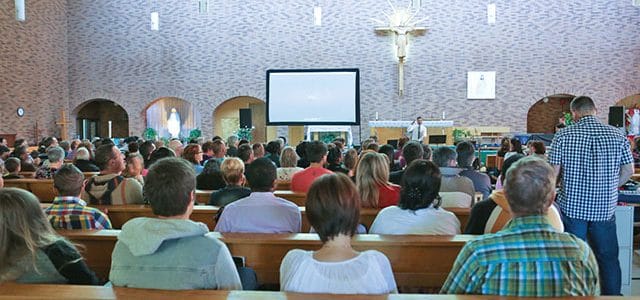
Catholic Church in Quebec sells sanctuary to Southern Baptist church plant

QUEBEC CITY  In a place steeped in religious history, a Baptist church plant in Quebec City, Canada, is redefining what church looks like for a local community and spreading the gospel of Jesus Christ among North America’s most unreached people group. 

In 2005, Église Communautaire Mosaïque was founded in downtown Quebec, one of the poorest parts of the city and also one of the most spiritually impoverished places in Canada. With evangelical Christians making up less than 1 percent of Quebec’s population, the native people, called Quebecois, are considered to be the least-reached people in North America, according to the North American Mission Board (NAMB). 

“One of the reasons they are so unreached is due to the negative impact the church had on their history,” said Chad Vandiver, NAMB Canada mobilization specialist. “This history resulted in the unfavorable definition of church the Quebecois have today.”

The Catholic Church dominated the culture, education and government in Quebec until recent decades, leaving behind dying churches and people with a religious history but little spiritual connection to the church. The vision of Mosaïque is to “revive the church in each community and to be a church in mission (to) incarnate the gospel through the love, hope and grace of Christ,” said the church’s pastor, Christian Lachance.

In keeping with its vision to be on mission in the community, the first of Mosaïque’s church plants opened in a theatre owned by a local soup kitchen that serves the city’s homeless population. The church grew and planted its second church in the Catholic Chapel of University Laval, where university students began sharing the gospel in that community and taking the gospel message back to their homes. 

Since Mosaïque’s early days, Lachance said its members also began reaching out to a local Catholic group, eventually leading to a partnership that resulted in an after-school program for local high school students.

“Because we focus on being a blessing in the community, we will be known as good people who are doing great things in the name of Jesus,” Lachance said.

As Mosaïque has grown in recent years, Lachance said the need to expand led to an “amazing opportunity to rent a Catholic church in the poorest neighborhood of all the city, with no evangelical church at all.” 

Each Sunday morning, the Catholic church holds its mass, followed by a service led by Mosaïque church members, Lachance said. After one year of this partnership, leaders from the Catholic church offered Mosaïque the opportunity to purchase the building to continue its mission in the community. 

Though Lachance said it is a great opportunity for Mosaïque, purchasing the building “is also a surprise we were not prepared for and that represents more than a simple investment.” 

The church now has the funds for the down payment but is looking ahead to possible renovations in the future, as well as purchasing a new sound system, Lachance said. Despite these challenges, Lachance said establishing Mosaïque’s presence in the former Catholic church will allow the congregation to be on “mission like never before.” 

“We also could have such a wonderful opportunity to have influence in the Catholic Church beyond our city,” Lachance said, adding that the facility will help Mosaïque’s goal to plant 10 churches in the greater Quebec area by serving as a place to train new leaders. 

By establishing a new and growing church in a place once marked by an empty religious culture, Vandiver said Lachance and Mosaïque are “redefining church for the Quebecois in a way they can understand and respond to.”

“He is planting an evangelical church in a Catholic sanctuary in order to minister directly to the historical problem the Quebecois have had with churches. … Never before has there been such a tangible opportunity for Southern Baptists to reach an unreached people group on their own continent through the multiplication of church plants,” Vandiver said.

Church restart provides fertile ground for healthy growth

EULESS With fewer than 30 members in the congregation, Foundation Baptist Church in Euless held its first worship service in September 2014. But the humble start was the beginning of new life for a fellowship that nearly closed its doors altogether several months earlier. 

North Euless Baptist Church had been slowly dying when it came to a crossroads. 

“The church was barely functional, spiritually dead, and it had completely stopped growing,” said church member David Kennedy. 

After seeking direction from the SBTC church revitalization team, the church’s leaders decided not to close but instead to replant under the leadership of First Baptist Church Keller. 

“The whole goal when you restart a church—replant it—is that it will begin making a community impact once again for the cause of Christ,” said Kenneth Priest, who leads church revitalization efforts for the SBTC. 

In May 2014, North Euless Baptist Church held its final service and closed its doors. The following month renovations began on the church’s building, and members met Casey Lewis, who would become the pastor of the newly formed Foundation Baptist Church.

When Lewis, along with his wife and their family, took on the role of leading the church plant, he said the congregation was in a state of brokenness. 

“The Lord began the process of breaking them. They were to the point of being broken when I came on the scene,” Lewis said. 

Nearly two years after Foundation Baptist Church officially began, membership now stands at about 80, and attendance at Sunday worship services reaches more than 100 people. 

While the numerical growth is important, Lewis said the changes in the church are seen in more than only numbers. 

“The greatest thing God has been doing is spiritual growth,” he said. 

Once Foundation BC opened its doors as a new church, remaining members went through a new membership process that focused on being a healthy, growing church. 

Kennedy, who was part of North Euless Baptist Church for more than a decade, and remained through the replant, said the once-dying church now “strives to worship God and know him fully.”

“We are committed to sharing the gospel in our community, making disciples and studying the Word of God so that he may be glorified in everything we do,” Kennedy said.

In going from a dying church to a thriving church, Lewis said two emphases have been key—preaching the gospel and making disciples. 

The latter, he said, was an area in which the church formerly struggled. 

“We cannot become consumed with ourselves. We have to make disciples where we are as well,” Lewis said. “That was really the major problem. They weren’t known as a church who cared about the community.” 

The church now hosts regular community events and goes out into neighborhoods and apartment complexes to meet people and share the gospel with them. 

“I want these people to know that we love them and we truly care about them as individuals, but to be successful we have to share the good news,” Lewis said.

Because of the community involvement and evangelism, several new couples have joined the church, and church members have begun to share the gospel regularly with family members, friends, coworkers and acquaintances. 

“At the first event that we did with (Foundation), one of the elders came up and handed me a tract and said, ‘Ok, go share the gospel with that girl,’” Brittany Thompson, who joined Foundation BC with her husband last summer, recalled. “It was kind of scary, but I had never seen a church function like that before, where they pushed you to share the gospel.” 

Matt and Brittany Thompson were attending a large church, but after a couple of years there, decided to look for a smaller church where they could be more involved. In June, the Thompsons attended Foundation Baptist Church, and after one visit decided to stay. Though they were the youngest couple attending the church at the time, Matt and Brittany said they found true community there.

“We’re getting bigger, but we still have kept everybody together. Everybody is still one family, and that’s really cool to see among the ages,” Brittany said. 

The Thompsons now disciple another couple from the church who recently became believers, and they continue to be challenged to grow spiritually and to share the gospel with others. 

“It’s interesting to see at Foundation how in everything they do, their goal is to be biblically centered in doing it, and it’s really refreshing to hear the pastors and the other leaders in the church continuously going back to the Bible, and continuously ensuring that what they’re doing follows biblical principles and that they’re all in community with one another and abiding in Christ,” Matt Thompson said. 

Lewis said this emphasis is the basis for everything the church does now and the reason for its continued growth.

“We’ve just been faithful here to preach God’s Word. He’s the one who brings the growth. We can’t take any credit for that. We’re striving to be faithful,” he said.

Learn more about church revitalization at sbtexas.com/church-revitalization.

Jacksonville College graduate seeks to be disciple maker

JACKSONVILLE  Joe Allen was 5 years old when his family answered a call to serve as missionaries in Brazil to the Hunsrik people, a culture that taught Joe about the importance of family and relationships. The Hunsrik people speak an ancient Germanic dialect that had no written form until the Allens began working with Wycliffe Bible Translators and other groups to translate the Gospel of Luke and 70 Bible stories into print and audio formats. 

For 12 years, Joe’s parents, Daniel and Teresa Allen, started house churches by making disciples in the Hunsrik community. According to Daniel, he and Teresa never considered Joe and his brother John to be ‘missionary kids.’ 

“They were missionaries with us,” he said. 

As early as age 8, Joe and John played guitar accompaniment along with their father during worship services in the homes of Hunsrik people. 

“In the house churches people would ask questions, and Joe would share insight that God had given him,” Daniel recalled. “We could see then that the Lord’s hand was on him.” By age 14, Joe was leading worship.

Though their work with the Hunsrik people continues long distance and via short-term mission trips, Daniel’s failing health necessitated a return to the states when Joe was 17. They live on a farm in Rusk, Texas, and Daniel serves as the pastor of Tyler St. Baptist Church in Jacksonville.

Joe completed high school but was unsure of what to do next until he accompanied a friend to the Jacksonville College campus three weeks prior to the start of the fall 2013 semester. Jacksonville College, the only Christian two-year liberal arts college in Texas, is owned and operated by the Baptist Missionary Association of Texas and has been affiliated with the Southern Baptists of Texas Convention since 2004.

“As soon as I set foot on the campus, I felt God say, ‘You need to be here. You need to go to college,’” Joe said.

Able to enroll with a full tuition scholarship, Joe is deeply grateful to the college for the training, encouragement and opportunities he received there. 

“I got to be in a place that prayed before class and challenged you to grow in your relationship with the Lord. I wasn’t a number but a person—every teacher knows your name,” he said.

As a student, Joe reciprocated the caring that he felt from his professors. Academic Dean Marolyn Welch told the TEXAN, “Joe is always ready to give a word of encouragement. He has prayed for me during difficult times of caring for my father.”

Family friend and faculty member David Heflin described Joe as one who invests his time wisely and focuses on doing everything for the glory of God. 

“He had fun doing Christian skits, acting in talent shows and joking with his friends; but because he cared about people, his conversations would always eventually lead to Jesus,” Heflin said.

While at Jacksonville, Joe took on numerous leadership roles, including guitarist and president for the Jacksonville College choir and a leader of the student praise band. He often brought the message in the Wednesday chapel service. 

Joe also participated in the Jacksonville College Ministerial Alliance—a group of students who sense a call to ministry, support each other and conduct service projects together in the community. Jacksonville College President Mike Smith told the TEXAN Joe shared the plan of salvation at the alliance’s community-wide Easter egg hunt. 

Smith has often relied on Joe to represent the college at events like association meetings and SOAR, a youth evangelism conference. 

“When churches call us and say, ‘We would like to have a student preach or talk about the college,’ I have called on Joe,” Smith said. 

In Joe’s sophomore year, a spiritual renewal took place on Jacksonville’s campus through which more than 100 decisions were made for Christ. One of those decisions was a young man to whom Joe and his family had ministered in Brazil, a foreign exchange student at Jacksonville College.

Joe marveled over God’s timing in reaching his Brazilian friend: “He finished his first year, and then he got saved at the revival.” Though the Allens’ ministry in Brazil seemed to have no impact on the young man or his family, Joe continued, “We saw him come to the Lord four to five years after we left Brazil. Now he is discipling his family in Brazil.”

During the college’s time of revival, Joe himself became more deeply committed “to be the next generation to impact lives and change the world.” 

Though his musical and speaking gifts provide him with public opportunities, Joe noted that his passion is not to be on a stage but to use that as a platform to work with individuals. Outside of their Jacksonville College roles, Joe and his 19-year-old brother John—“The Allen Brothers”—take their own message to heart by taking their music on the road. They have traveled across Texas filling in as worship leaders and instrumentalists. 

“While we do this, we are discipling,” Joe said. “We will teach people who maybe could not even play, and sometimes we are able to leave the church with an established praise and worship team.

“I want to share what God has done in my life with people—spending time, going to lunch, or passing them in the hall and asking how their day went. That is where disciples are made—taking the time to breathe and invest in people. That’s what Christ did, and I want to do the same.”

In May, Joe completed an Associate of Science degree with a 4.0 GPA, graduating summa cum laude from Jacksonville College, with plans to major in music at East Texas Baptist University. His dream is to hear Jesus say, “Well done, my good and faithful servant.”

“Pass the Salt”: Racism cure resides with church

ST. LOUIS Racial reconciliation rests at the doorsteps of the church and can only be achieved through the gospel in action, a diverse panel of Baptist pastors said during a trailblazing discussion June 14 on the opening morning of the 2016 SBC annual meeting in St. Louis.

Southern Baptist Convention President Ronnie Floyd convened the panel, historically including National Baptist Convention USA President Jerry Young. The two have collaborated for months to put talk into action and actually achieve racial reconciliation in a racially troubled America.

All members of the panel expressed a unity of vision and purpose, describing the church as the Light and Salt of the earth, and the only cure on this side of heaven for racism.

Referencing Jesus’ words in Matthew 5:16, Young, pastor of New Hope Baptist Church in Jackson, Miss., said racism is a sin problem that can only be solved by the people God has put in place to offer the healing salvation of the gospel.

“The problem in America is a problem with the church being what God called it to be,” Young said. “The problem [is] contaminated salt, concealed light, whereby we do not express the love of Christ nor extend His light.”

“Somebody needs to pass the salt and turn on the light.”

David Um, senior pastor of Antioch Baptist Church in Cambridge, Mass., and chaplain at the Massachusetts Institute of Technology, said the smartest people in the world have invented no cure for racism.

“The students I encounter at these elite and intellectual institutions are most certainly not racist. Just ask them. They are the enlightened ones,” he said with sarcasm. “They have evolved beyond racial divisions … or so they assume.”

But they are “completely blind to their personal biases and bigotries.”

Um concluded, “You cannot educate away racism because you cannot educate away sin. Sin is the problem. Racism is just another sin.”

Former SBC President Fred Luter Jr., pastor of Franklin Avenue Baptist Church in New Orleans, also served on the panel. Other panelists were Marshall Blalock, pastor of First Baptist Church, Charleston, S.C.; Kenny Petty, pastor of The Gate Church in St. Louis; H.B. Charles, pastor of Shiloh Metropolitan Baptist Church in Jacksonville, Fla.; Timmy Chavis, pastor of Bear Swamp Baptist Church, Pembroke, N.C.; Joe Costephens, pastor of First Baptist Church, Ferguson, Mo.; D.A. Horton, pastor of Reach Fellowship, Los Angeles, and Gregg Matte, pastor of First Baptist Church, Houston.

Floyd described the SBC as the most multi-ethnic and multi-lingual denomination in America, with 10,709 of the 51,441 churches and mission churches holding non-Anglo majority memberships. Of almost 1,000 churches planted in America two years ago, 58 percent were non-Anglo, Floyd said.