Month: August 2025

SBTC committee to review constitution and bylaws

GRAPEVINE—The Southern Baptists of Texas Convention Executive Board has authorized forming a committee to review the convention’s constitution and bylaws. The last update was in 2020.

Committee members were appointed by Executive Board Chairman Steven Gaither and include board members and non-board members: Denny Autrey (chairman), Deron Biles, Dalia Gonzales, Jason Gray, James Jordan, Amy Joslin, Aaron Kahler, Averri LeMalle, and Spencer Plumlee. SBTC Executive Director Nathan Lorick and Executive Director Emeritus Jim Richards will be non-voting, ex officio committee members.

The committee will review the documents in their entirety to ensure the convention’s polity and affiliation requirements are clearly stated, particularly as they relate to the office and title of pastor.

“The Executive Board remains committed to keeping our governing documents rooted in biblical conviction and marked by clarity. I am thankful for the committee members who willingly offer their time and wisdom to serve our convention, guiding us forward in unity and faithfulness,” said Gaither.

The committee will recommend amendments to the Executive Board. Proposed amendments will be published 90 days before being voted on by the messengers at the 2026 Annual Meeting. Constitutional amendments require an affirmative vote at two consecutive annual meetings before becoming effective.

“Processes like this are both necessary and beneficial to the health of any ministry organization,” said Lorick. “I look forward to the committee’s work and the recommendations the Executive Board will ultimately present to the messengers.”

‘I just don’t think about Jesus’

Curious Muslim illustrates the gospel opportunity that exists in Denmark

BRØNDBY STRAND, Denmark

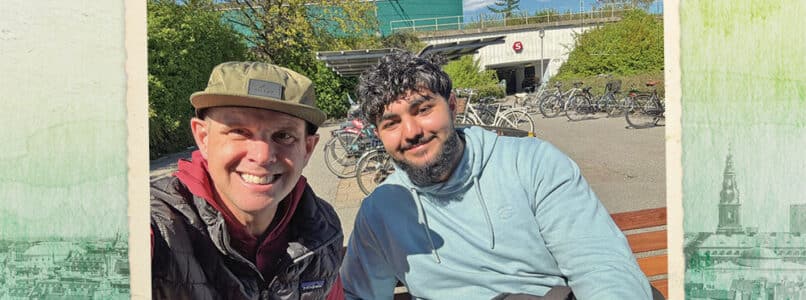
Yousef was waiting for the next train in this Copenhagen suburb on a crisp, sunny day when a group of Americans—Texans, specifically—stepped onto the platform to wait alongside him. 

The 17-year-old is a native Dane, though his parents are Pakistani. He’s a Muslim, but mostly in name only. He doesn’t practice the Salah—a central pillar of Islam requiring prayer five times per day—and he doesn’t go to the mosque often.

Michael Criner, lead pastor of First Rockwall, was among the Texans on the platform that day. Criner, along with a handful of other pastors and church leaders, was in country as part of the Southern Baptists of Texas Convention’s Reach Europe vision tour in early May. 

The purpose of the trip was to introduce SBTC pastors and church leaders to missions opportunities across the continent with the hope of facilitating long-term ministry partnerships. The SBTC, working with the Southern Baptist Convention’s International Mission Board, is targeting seven European cities, including Copenhagen.

Criner struck up a conversation with Yousef, asking about his background and his life in Denmark. He also asked the teenager what he thinks about Jesus.

“Here in Denmark, as a Muslim, I just don’t think about Jesus,” Yousef said.

Even so, Yousef admitted he is curious about Christianity and has watched online videos of Muslims debating Christians. He is also interested in the Trinity and had questions about that. Before their interaction ended, Criner—the first Christian Yousef said he’d ever met—shared the gospel with the teenager.

“Three times, actually,” Criner said later, recounting the conversation.

Ultimately, Yousef did not make a decision to follow Jesus. But …

“You gave me something to think about,” he told Criner. And with that, the two parted ways. 

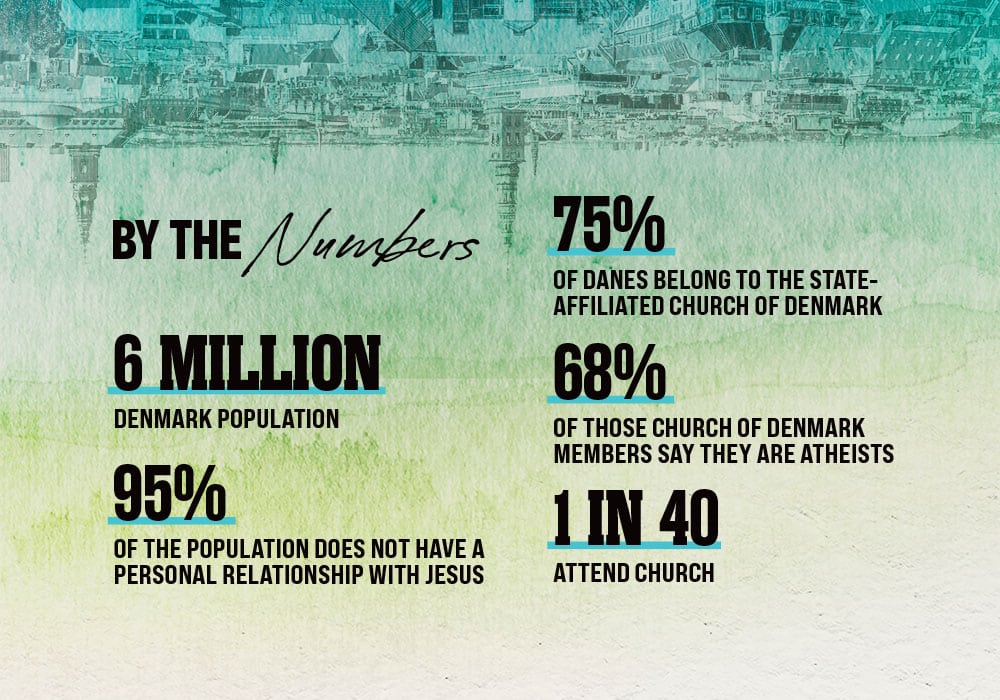
Yousef is among a countless number of Danes who claim a religious identity that exists apart from a practicing faith. For example, the country has a rich Christian history, and yet more than 95%—and likely more—of the country’s 6 million residents do not have a personal relationship with Jesus Christ. About 75% of Danes belong to the state-affiliated Church of Denmark, which performs infant baptisms. Sixty-eight percent of those people, however, say they are atheists. Less than one in 40 attend church.

SBTC churches that partner in Copenhagen will work with IMB personnel in an urban context to serve established Danish churches in revitalization efforts while working alongside missionaries and local believers to engage people with the gospel.

During a debrief with other pastors and leaders near the end of the trip, Criner noted that Copenhagen is a beautiful city and one that might be a smooth entry point for churches because most residents there speak English. He also said SBTC churches that choose to partner in Denmark will find opportunities to encourage the IMB missionaries serving there: Christian Roth, pastor of New Song Church, his wife, Stephanie, and their four children. 

The Roths are the IMB’s only missionary unit on the field in Denmark and Sweden, where Christian was born.

“They are anchored. They are called to Denmark,” Criner said. “They are called to [this region]. They are not going anywhere. If you love pouring into pastors and you’re looking to help plant a church in Denmark and Sweden, this is your team.”

Update: 2025 SBTC Mid-Year Giving Report

Due to an error during the editing process, the column headers on the 2025 Mid-Year Giving Report published in Issue 6 of Southern Baptist Texan magazine were transposed.


An updated version of this report, which includes the giving categories listed in correct order, can be found here.


All gifts were correctly applied as directed by each giving church. 

Amid wars and rumors of wars, a promise of comfort

Like many of you, I have been watching closely the events in the Middle East as Israel and the U.S. wage war against Iran. My heart breaks for all those who are suffering in every country. While most Southern Baptists unequivocally support Israel and the U.S., that does not mean we are against people in other countries. I pray for new leadership in countries like Gaza, Iran, and Russia. But there is coming a day when Jesus returns and all wars will cease. No more suffering, invasions, genocides, hunger, etc.  

I love the doctrine of eschatology, which means a study of last things. My great-grandfather, Samuel Isaacs, was an evangelist who lived to be 99 years old. His passion in ministry was the return of Christ and the study of last days. I visited him when I was 17 years old while he was in a nursing home in Oklahoma. He was so passionate about Jesus, and when he began to speak about the Lord’s return, I was thinking the Lord might come back that moment and get him!  

For years I have studied end times prophecy, especially as it is revealed in the book of Revelation. I have preached verse by verse twice through this entire book. There is much mystery regarding the Lord’s return and vigorous debate on important doctrines like the rapture of the church, the great tribulation, and the millennial kingdom. But there is no doubt over the fact Jesus will indeed come back. He promised to do so in John 14:3: “And if I go and prepare a place for you, I will come again and receive you to myself; that where I am, there you may be also.”

"The best thing we can do as followers of Jesus is pray, stay ready, and help as many people as possible come to know Jesus Christ before it is too late."

Scripture teaches repeatedly that Jesus will indeed come back. For example, Acts 1:11 states, “Who also said, ‘Men of Galilee, why do you stand gazing up into heaven? This same Jesus, who was taken up from you into heaven, will so come in like manner as you saw Him go into heaven.’” First Thessalonians 4:16-18 says, “For the Lord Himself will descend from heaven with a shout, with the voice of an archangel, and with the trumpet of God. And the dead in Christ will rise first. Then we who are alive and remain shall be caught up together with them in the clouds to meet the Lord in the air. And thus we shall always be with the Lord. Therefore comfort one another with these words.”

There will be wars and rumors of wars until Jesus comes. The best thing we can do as followers of Jesus is pray, stay ready, and help as many people as possible come to know Jesus Christ before it is too late.

As I approach the end of my time as the president of the Southern Baptists of Texas Convention, it has been a privilege to serve the Lord and our convention. I hope to see you at our annual meeting Oct. 27-28 at Southcrest Baptist Church in Lubbock.

For deep East Texas church, Cooperative Program is as much about going as giving

Calvary Baptist Church made a commitment years ago to tithe on their receipts by giving 10% through the Cooperative Program to support national and international missions and ministries.

“We have kept that [up] through these years,” said Paul Sevar, Calvary’s senior pastor for more than 25 years. 

The church—in a relatively rural area in deep East Texas—has believed in the purpose of the Cooperative Program so much that they “have not missed” what they have given to the kingdom through Southern Baptist work. 

“We very much feel that the Cooperative Program has been a gift to us from God to be able to reach out across our world,” Sevar said. “Whenever you’re able to keep missionaries on the field, it is so important that they don’t have to come home and raise their funds to go back to the mission field.”

Sevar’s wife grew up in a denomination whose missionaries routinely had to leave the field for three or four months at a time to raise support, so that difference in the Cooperative Program is vivid to him. 

“The Cooperative Program is that which keeps our missionaries there to do the work,” he said. 

Children’s ministry at Calvary Baptist Church in Nacogdoches is a key component of training the next generation. SUBMITTED PHOTO

Rarely will someone at Calvary question why so much money needs to leave the church, but Sevar aims to be transparent about why they give. Twice a year, he preaches on missions giving, and church members are invited to talk about it individually if they have questions.

Though in the same town as Stephen F. Austin State University, Calvary has realized through the years that they are “not the college church.” Congregations closer to campus have been more successful at reaching students, and though Calvary has outreaches and some college students attend, the church knows its identity, Sevar said.

Evangelism is a key strategy for reaching the lost in Nacogdoches. Every Monday, church members go into the community to knock on doors. 

“We’re seeing a number of people who are coming to church that used to be in church years ago, and now they’re coming back to church,” Sevar said. “I have to say, it’s because of outreach. It’s because members of the church are out knocking on people’s doors.”

The pastor believes church members knocking on doors, asking to pray for residents, and talking about Jesus is a method the Holy Spirit uses to refresh minds about Christ. “All of a sudden, the Holy Spirit begins to move and convict them,” Sevar said.

Sevar admits times have changed, noting most people would invite him into their homes when he knocked on their doors in the past. More often these days, such invites are not as frequently extended—and some say they don’t even want anyone to pray for them. 

Even so, “if you confront them, the majority of them will listen to you. They won’t all reject you.” Kindness and graciousness go a long way, he said, and often residents will respect people for being bold enough to share their faith. 

“We very much feel that the Cooperative Program has been a gift to us from God to be able to reach out across our world.”

Baptisms at the church can partly be traced to an emphasis on door-to-door evangelism.

With up to 350 attending Calvary on Sundays, they have baptized about 15 people this year. Sevar said the church was baptizing about every other week during one stretch. 

In addition to strong missions giving and evangelism, Calvary goes on mission trips to San Francisco and Belize, where they helped build a church. They are involved in their local Baptist association, a food pantry, and other ministries to advance the kingdom. 

“Calvary has been consistent through the years. We have stayed faithful to not only giving money toward missions, but doing missions,” Sevar said. A long tenure has given him the chance to see the church’s steady impact on its community. 

Methods have had to change, he said, as Sunday night and Wednesday night attendance has dropped in recent years. To compensate, Calvary started weekday Bible studies at times and in groupings that fit busy schedules. The church has anywhere from 80 to 130 people in those studies throughout the week.

Sevar emphasizes the need to continue presenting God’s Word to people and inviting them to follow Jesus. Though church today doesn’t look like it did when he fell in love with it as a boy, it is as critical to God’s mission as ever.

“This church has been such a great, consistent church serving the Lord,” Sevar said, “and we truly believe in the cooperative effort.” 

Gonzalez ready to mobilize churches as new leader of SBTC En Español

GRAPEVINE—In early August, Luis Gonzalez began working as the full-time director of the Southern Baptists of Texas Convention’s En Español ministry. In his first days on the job, he began familiarizing himself with staff and connecting with pastors, church planters, and associations.

“I’m so grateful to be a part of this team,” Gonzalez said. “We want to mobilize our churches to make disciples and to do it with excellence.”

There are many ways SBTC En Español will do that, he added, including providing more resources to better equip Hispanic pastors. “[When we do this], we will see more of our churches accomplish the mission of making disciples and seeing many people come to Christ,” he said.

Gonzalez is joining SBTC En Español at a time of encouraging growth and engagement among the churches it serves. This past year, the ministry’s anchor events—the Hombres de Impacto men’s conference and the Florece women’s retreat—drew 650 and 750 attendees, respectively. Youth Week summer camp had 540 students registered from 26 churches, and Spanish sessions at events such as Apoderados, held in conjunction with the annual Empower Conference each winter, continue to see increasing participant numbers.

Gonzalez is no stranger to those events, having served as a volunteer helping organize and promote them. He has also served on the SBTC Resolutions Committee, as well as with Send Network SBTC, the church planting partnership between the SBTC and the North American Mission Board, supporting new planter assessments.

He comes to the SBTC having previously served as the Hispanic pastor for Lamar Baptist Church in Arlington, a position he had held since 2016.

Julio Arriola, who served as Send Network SBTC’s director for several years before answering a call to serve Cross Church in Arkansas earlier this year, said Gonzalez’s Christlike character, servant leadership, and unwavering commitment to advancing the gospel among Hispanic churches made him a perfect choice to lead SBTC En Español.

“Beyond his credentials, it is his heart for the local church, his vision for discipleship, and his ability to collaborate cross-culturally that makes him such a vital leader in our convention,” Arriola said.

J.J. Washington, the North American Mission Board’s national director of personal evangelism, said Gonzalez exceeded his expectations this past year when he reached out to ask him to mobilize Hispanic churches for the Crossover 2025 event held prior to the Southern Baptist Convention Annual Meeting in Dallas.

“I set a goal for Luis to mobilize 15 Hispanic churches, but Luis set a personal goal of 30 churches, and he achieved it,” Washington said in recommending Gonzalez to lead SBTC En Español. “Luis connected with pastors over lunch and coffee, at associational gatherings, state events, etc., and suddenly the registration numbers for Hispanic pastors and churches increased. … He is a man of God, he has integrity, he is a self-starter, he is very dependable, and he loves serving pastors.”

Gonzalez led Lamar’s Crossover groups in English and Spanish, resulting in more than 25 people coming to faith in Jesus Christ.

“It was a beautiful blessing to welcome missionaries and to witness how the whole church came together in unity, moving forward faithfully in the mission of making disciples—all for God’s glory,” Gonzalez said.

Gonzalez said he is grateful for the opportunity to lead SBTC En Español, thanking the SBTC’s senior strategist of Missional Ministries, Tony Mathews, the Executive Committee, and Executive Director Nathan Lorick.

“We’re confident Luis will excel in leading our Hispanic ministries and make an incredible contribution,” Mathews said. “It will be a joy working with him.”

Added Lorick: “We are really excited to have Luis join us to lead our SBTC En Español ministry. I believe great days are ahead under his leadership.”


CP is an impact equalizer

I grew up the son of a Baptist pastor in rural Louisiana. Most of the churches my father pastored were small, but all of them had a big heart for missions. My mother was an active part of that ministry and involved in an organization called the Women’s Missionary Union. This group of ladies kept the church informed about mission efforts around the world. 

As a child growing up in that environment, this was my first exposure to world geography. I heard stories of people and places far away. To my amazement, I was told many of these people in distant lands had never heard about Jesus. 

Of course, I could not remember a time I had not heard of Him, so that seemed impossible. At an early age, we were taught that it is the responsibility of every Christian to share the gospel with the world. But I remember thinking, “How can a small rural church and a child make a difference around the world?” Our church had limited resources, and I was just a kid. 

The answer was the Cooperative Program. By joining hands with thousands of other churches around the world through prayer and giving, small congregations can make a global impact and fulfill the Great Commission. Somehow, even as a child, that made sense. Of course! If we could put our offerings with others, we could get enough to make a difference. 

Today, I am the pastor of a larger church, and the Cooperative Program affords us the exact same opportunity to make a global impact and fulfill the Great Commission. In the small churches I grew up in, missionaries would visit and share stories that captivated our attention and confirmed we were part of what God was doing on the mission field. 

I am privileged today to have many from our church who have answered the call to missions, so for us, the Cooperative Program is very personal. 

Our church partners with many of our missionaries and goes on mission trips around the world on a regular basis to share the gospel. This connection has made a huge difference in our day-to-day ministry. We have become a globally minded church, and that has translated into a desire to reach our neighbor across the street. We often ask our members, “Is your passport current?” That is our way of saying be ready—He may call at any time. 

It is easy to think a larger church can make a global impact in a way a smaller church cannot. Yet because of the Cooperative Program, even churches that do not feel they have a personal connection with missions or are not able to go on a mission trip are just as connected as our church. Here is the genius—if a church gives through the Cooperative Program, each church member has a personal connection to over 3,500 international longterm missionaries and thousands of others serving in North America. This means small and large churches are equal in cooperation as they seek to fulfill the Great Commission. 

The Cooperative Program is not just what we do. It is a part of who we are.

IMB missionary in Europe reaches ‘Andrew’ with gospel

Editor’s note: To learn more about how your church can become involved in the SBTC’s ministry partnership with the IMB in Europe, visit the SBTC’s Reach Europe information page. 

Joseph Hazen’s phone rang, and he answered to hear the voice of his North African friend. Hazen, an International Mission Board missionary, and his friend have served together for almost 20 years in a large European city, sharing the gospel on the bustling streets with people from all walks of life.

Hazen and his friend team up with other Christians to connect with passersby, offering coffee, tea, Bibles, and other evangelistic materials. Usually, two people supervise the table of beverages and literature, while other team members wait to spark conversations. On a daily average, team members have three to 10 conversations and distribute 500 to 700 tracts that feature contact information for the purpose of follow-up meetings.

Hazen’s friend called to share a conversation he had with a law student named Andrew. This young man previously picked up a gospel tract which had the friend’s contact information. Since Hazen’s friend lived outside of the city, he asked Hazen to follow up with Andrew.

Hazen discovered that Andrew hadn’t slept for three nights. He was in the throes of depression. The young man came from a difficult home life, with a father who had multiple wives. He was living with a brother while going to law school.

Hazen shared the gospel with Andrew, and they continued to talk every day that week. Each time they spoke, Andrew asked deeper questions about the Christian faith, and he also expressed that he was sleeping better each night.

Later that week, Hazen invited Andrew to join him and his ministry team on Saturday at a well-known place in the middle of the city. Andrew showed up and observed the team engaging people.

One encounter involved an older man who came with a scowl on his face. He did not agree with what the team was sharing, and the conversation he was having with Hazen became heated.

Then, something unexpected happened. Andrew got involved in the conversation and boldly shared with the man that Jesus is the Son of God. “I have given my life to Him, and you should too!” Andrew exclaimed.

This marked a significant transformation in Andrew’s life. He found relief from his depression and became a follower of Christ, demonstrating a remarkable boldness in sharing his faith.

Andrew got involved in a church discipleship program, and he even invited a friend to join. Both young men were recently baptized, celebrating their new faith.

Continue to pray for Andrew and his friend as they grow in their faith. Pray for the ministry of Hazen and his teammates, as they continue to connect with people like Andrew and share the gospel to those who need to hear it.

Names changed for security.

This article was originally published IMB.

In a world of uncertainty, you can always trust this

The question of why we can trust the Bible as the authoritative Word of God is foundational for every Christian. In a world where truth is often seen as personal to your preferences and opinions, the Bible claims to be from God and authoritative, regardless of your preferences and opinions.

The Scriptures are the divinely inspired revelation of God to His creation: humanity. This claim carries weight because the Bible speaks not only about history and morality but also about the nature of God, humanity, salvation and eternity.

To understand and trust the Bible’s authority, we must explore its inspiration, inerrancy, historical reliability, and transformative power.

The inspiration of Scripture

One of the most fundamental reasons we can trust the Bible as the authoritative Word of God is because of its divine inspiration. The doctrine of inspiration teaches that the Bible is “God-breathed” (2 Timothy 3:16). This means that while human authors wrote the individual books of the Bible, they were guided by the Holy Spirit to record God’s Word without error.

Peter, one of the disciples of Jesus, elaborates on this concept: “Above all, you know this: No prophecy of Scripture comes from the prophet’s own interpretation, because no prophecy ever came by the will of man; instead, men spoke from God as they were carried along by the Holy Spirit” (2 Peter 1:20-21).

This passage underscores the belief that Scripture is not the product of human imagination or effort but the direct result of God’s communication through the Holy Spirit.

R. C. Sproul defines biblical inspiration as the process by which “God superintended the human authors so that, using their own individual personalities, styles, and cultural contexts, they composed and recorded without error His message to humanity.” This divine inspiration ensures that the Bible contains God’s perfect and complete revelation.

Furthermore, Jesus Himself affirmed the authority of Scripture. In Matthew 5:17-18, He said, “Don’t think that I came to abolish the Law or the Prophets. I did not come to abolish but to fulfill. For truly I tell you, until heaven and earth pass away, not the smallest letter or one stroke of a letter will pass away from the law until all things are accomplished.”

Jesus affirmed the Scriptures were authoritative and unchanging, validating the Old Testament as the Word of God. His teaching, life, and death also fulfill the promises and prophecies within Scripture, further affirming its divine nature.

The inerrancy of Scripture

In addition to its divine inspiration, the Bible’s inerrancy is crucial to understanding its authority. Inerrancy means that the Bible, in its original manuscripts, is without error in all that it affirms, whether in matters of faith, history, or morality. If the Bible is truly God’s Word, then it must be free from error because God Himself is perfect and incapable of lying (Titus 1:2).

In John 17:17, Jesus prays to the Father, saying, “Sanctify them by the truth; your Word is truth.” This statement reveals that the Bible is not only true in the sense that it contains truth but that it is truth itself. The Bible does not merely conform to a standard of truth outside of itself; it is the very standard of truth because it is the Word of God.

Norman Geisler explains that “since God is the ultimate author of Scripture and God cannot err, it follows that Scripture cannot err.” This reasoning is foundational to our trust in the Bible. If the Bible contained errors, it would cast doubt on its claim to be the authoritative Word of God. However, the consistent testimony of Scripture is that it is trustworthy in all it teaches.

The historical reality of Scripture

The Bible’s trustworthiness is also based on its historical reliability. The Bible records real historical events and people, many of which have been confirmed by archaeological discoveries and external historical sources. The historical accuracy of the Bible lends credibility to its claims of divine origin.

For example, the discovery of the Dead Sea Scrolls in 1947 provided substantial evidence for the accuracy of the Old Testament text. These ancient manuscripts, dating back to the second century B.C., closely match the Hebrew text we have today, demonstrating the careful transmission of Scripture over the centuries.

Additionally, numerous historical figures and events recorded in the Bible, such as King David, Pontius Pilate, and the destruction of Jerusalem, have been corroborated by external sources. Archaeologist Nelson Glueck stated, “No archaeological discovery has ever controverted a biblical reference.” While archaeology cannot prove the divine inspiration of the Bible, it does confirm the Bible’s reliability as a historical document, which strengthens our confidence in its truth claims.

The New Testament, particularly the gospels, also stands up to historical scrutiny. The gospels were written within a few decades of Jesus’s life, which is an extremely short time frame for ancient documents. The authors of the New Testament, many of whom were eyewitnesses to the events they recorded, had firsthand knowledge of Jesus’s life, death, and resurrection.

The apostle Paul, writing in 1 Corinthians 15:3-8, recounts the appearances of the risen Christ to over 500 people, many of whom were still alive at the time of his writing, encouraging readers to verify the truth of the resurrection for themselves.

The transformative power of Scripture

Finally, the Bible’s authority is confirmed by its transformative power. The Bible is not just a collection of ancient writings; it’s the living Word.

The writer of Hebrews 4:12 tells us, “For the Word of God is living and effective and sharper than any double-edged sword, penetrating as far as the separation of soul and spirit, joints and marrow. It is able to judge the thoughts and intentions of the heart.” Through the Bible, God speaks directly to His people, convicting them of sin, comforting them in suffering, and guiding them in truth.

The Bible’s power to transform lives is evident throughout history. Countless individuals, from Augustine to Martin Luther to modern-day believers, have testified to the life-changing impact of God’s Word. Charles Spurgeon once remarked, “The Word of God is like a lion. You don’t have to defend a lion. All you have to do is let the lion loose, and the lion will defend itself.” This analogy highlights the Bible’s power to defend itself by its transformative effect on those who read it.

Scripture has also played a central role in shaping cultures and societies. The principles of justice, human dignity, and morality found in the Bible have influenced legal systems, governments, and social movements throughout history. From the abolition of slavery to the civil rights movement, the Bible’s teachings have inspired transformative social change, testifying to its authority as a guide for living.

The Bible can be trusted

We can trust the Bible as the authoritative Word of God because it’s divinely inspired, inerrant, historically reliable, and transformative. The Bible stands apart from all other books because it isn’t merely the product of human effort but is the very Word of God, breathed out by Him and preserved for us. Its teachings are true, its historical claims are reliable, and its impact on individual lives and society is undeniable.

As Christians, our faith is built on the solid foundation of God’s Word. In a world of shifting opinions and unreliable sources of truth, the Bible remains the unchanging, authoritative guide for our lives. As we study Scripture, we can be confident we are hearing the voice of God, who has revealed Himself to us through His Word. When the Bible speaks, God speaks.

It is through this Word that we come to know the real Jesus and understand what He calls us to be and do.

‘All of His creations are beautiful and special’

My husband Jonathan and I came to First Baptist Church in Mansfield in 2018. We both grew up in Fort Worth and had lived in Houston for a time while he finished law school. I worked full time for Child Protective Services for almost nine years, and to me, that was a ministry working with an underserved people group that needs love. It was very important to me. 

We started our family, moving back to Dallas-Fort Worth after law school, and our first daughter, Emilia, was 2 when we joined First Mansfield. I was pregnant with our second daughter, Julianna, when COVID hit. She was born right in the middle of the lockdown, so we attended church from home for a long time just because she was so little. 

Julianna is now 4. She has a genetic disorder called Rett Syndrome. It’s a mutation on the X chromosome and it affects the development of a specific protein in her brain. That protein works with retention of developmental skills. Rett Syndrome is very rare. It’s found in 1 in 15,000 female births. For girls, they have a second X chromosome that allows it to counteract the mutation. When you have a child with Rett, they appear to be developing normally. The syndrome has four stages. Stage one is normal development. Stage two can arise anywhere between 12 months old and 3 years old and is the regression stage. Julianna had words, she could say, “mom,” “dad,” “bunny,” “book.” And then over time she just stopped talking. She was able to use a straw and pick up food with her fingers, the fine motor skills, and then she just didn’t. She was very slow to walk.

You dream of your children going to college and getting married and having children, and that child disappeared. I’m in a better place now because I know it’s not the plan I had for her, but there’s a plan God has for her and it’s going to be beautiful. But I just had to have that moment of the grief of losing the child I thought I would have. And then it affects the future of my older daughter, Emilia. At some point in her life, she will be a caregiver for Julianna. I’m so thankful for Emilia’s tender heart and love for people. That’s really helped me feel comfortable and confident in both of their futures. Emilia already talks now, at 8, of how she’s going to take care of Julianna when we’re not here anymore. And it touches my heart. I tell her that’s a long way away.

Julianna, Jonathan, Lindsey, and Emilia Moss are members of First Baptist Church in Mansfield. SUBMITTED PHOTO

When we started going back in person to First Baptist, we were in the middle of trying to figure out what her delays were. And that’s hard when thinking about telling a nursery volunteer, “Oh, she’s 20 months, but she doesn’t talk.” It was something we didn’t want to have to explain to a different person every time we went on Sundays when we didn’t really have answers. We needed to find a new life group since our former one was gone. We visited all the ones that catered to our stage of life. By that time, we had found out about Julianna’s diagnosis, and we hadn’t really mentioned it to anyone except our pastor, Pastor Spencer [Plumlee], and the preschool minister. In the life group we chose, there were three other families—two that have children with Downs and one that has a different genetic disorder that affects her mobility and bone growth.

I see now that God laid it on our hearts that that’s where we need to be. These are our people. And that was even before First Baptist had a special needs ministry. God was already doing things.

Jonathan and I now lead our life group that has some of those same families in it. A couple of Sundays ago, we were sharing our prayer requests and one of the moms was like, “I just now realized how many of our children have neurological issues.” We are able to support one another because it is such a journey with highs and lows, trying to figure out what’s best for our children when they can’t tell us. So being in the same circumstances with other families provides a camaraderie I guess, being in the same boat as each other and being able to support one another.

Jimmie Gillum is our second special needs minister and she’s done an amazing job growing the ministry. I think she’s brought something special to it, being the parent of an adult special needs child. That’s really going to help grow the ministry at our church even more, instead of just focusing on the young kids. 

We also have the parents’ night out respite nights. I volunteer with them, but I don’t take Julianna since I have extended family who would come watch Julianna any day of the week. I do volunteer because they’re so important. Jimmie’s done some family get-togethers, different events and activities so we can spend time with other special needs families outside of church time, and spending time with volunteers who are giving their time on Sundays during the life group hour and the service hour.

For Julianna, she has a buddy and there’s several, but two or three specific people will go with her. She’s 4, so she’s in the special needs classroom, but then she goes to the fours class and her buddy goes with her. She’s able to be around children her own age and then go back to the special needs classroom if she’s not feeling it. If she is, she stays the whole time and then comes back and we pick her up from there. 

My favorite verse is Lamentations 3:22-23: “Your mercies are new every morning.” Every day that I wake up and I see Julianna learning new things or developing new skills, it’s just a reminder that God’s not done, and she cannot be limited by a diagnosis. I’m thankful I have that outlook. Psalm 146:6 talks about God creating the heavens. Julianna doesn’t calm down like a normal child, and cuddling or holding doesn’t work either. Right after she’d been diagnosed, we had a screensaver on our TV that was constellations and galaxies, and I could put those pictures on and she would stop crying. We now have a starlight that shines up on her ceiling and it just brings her such peace. I was very thankful that Scripture can remind us that God is in control of all things. All of His creations are beautiful and special.

Jesus is Writing My Story logo

Want to share a story of what God is doing in your life or your church? 

Share your story here