
 English
 Korean
 Spanish
In France, followers of Christ are praying for long-term partners to reach one of the most secular countries in the world
‘Devoid of God’

In France, followers of Christ are praying for long-term partners to reach one of the most secular countries in the world

Editor’s note: This column was written by a member of the Southern Baptists of Texas Convention’s Shepherds Collective. For more information, visit sbtexas.com/networks/shepherds-collective.
There’s a saying that it takes a village to raise a child, and God’s village for raising godly children is the church. God has truly blessed me with a great village of men who have come alongside me to be the pastor I am today.
I began pastoring at 26. I knew I needed help if I was going to pastor well. God’s village stepped into this gap. I reached out to my godly friends and pastors regularly, and I’ve made many phone calls asking for help with problems I never thought I would have to counsel church members through.
It’s not that seeking godly counsel is a bad thing. In fact, it’s biblical. Proverbs 11:14 says, “Where there is no guidance, a people falls, but in an abundance of counselors there is safety.” Godly counsel is a blessing to all Christians and especially pastors.
But one of the things I’ve learned about myself over my years of pastoring is how quickly I am to rely on that village rather than on God’s Spirit for guidance. I was so quick to pick up the phone to call pastors who have served longer than me rather than prayerfully waiting on the Lord in prayer on things involving His sheep.
Over time, I realized that if I can get immediate wisdom from godly counsel, it would make my decisions quicker and more informed. What I didn’t realize was how unwise that was in the grand scheme of things.
God’s greatest help to the Christian and pastor is the Holy Spirit. He should not be my second choice, but my first. While it is tempting to seek godly counsel before God’s counsel because of the immediate answers it offers, it is better for us to seek God’s counsel first because He knows His sheep best. He also knows us pastors best! He knows our blind spots, frustrations, worries, and sin. He knows our gifts, experience, and where we thrive. I say this to remind us as church leaders that while it is crucial to have many mentors, counselors, and advisors to call on, we should call on the Lord before any of them.
One of the greatest challenges for pastors is their easy accessibility to resources and wisdom. If you don’t know the answer, someone has written a book on it. If you don’t have time to read the book, you can ask ChatGPT to summarize it. If you want to talk to someone about it, you can call your pastor friends. Immediate answers and immediate wisdom are just moments away.
But let me offer a better way forward. Go to the Lord in prayer before you call, Google, or ask. Is that groundbreaking advice? No, but it is the best advice I have. I have found that the more I seek the Lord’s counsel first, the better I can navigate the godly counsel of others, the better I can discern what I should and shouldn’t say, and the better I can relate to the sheep He has called me to care for.
Church leaders, you have myriad problems to navigate. People are looking to you to help them with their spiritual problems. Please seek godly counsel, but not until you have approached the throne of grace first.



Many Chinese come to America to find wealth.
This Plano church wants them to find Jesus.
MIAMI—José Abella’s parents grew up in Cuba before immigrating to the U.S. in the 1960s, but he’s spent his entire life here. Abella says this multicultural pull is both an advantage and an obstacle for Hispanic church planters.
Having planted Providence Road Church in Miami in 2010, Abella knows from personal experience the circumstances surrounding starting new Hispanic congregations. While still leading Providence Road, he was named vice president of Send Network Español, the North American Mission Board’s Hispanic church planting efforts, in 2024.
A Lifeway Research study found the average new Hispanic church work starts with 31 people in attendance but grows consistently. By the eighth year, the church sees an average of 85 people at the weekly worship service. All through that early season, they’re reaching 10 to 15 new people with the gospel each year.
The growth in Protestant Hispanic churches excites Abella. “It is a realization that the Lord is saving people from every tribe, nation and language,” he said. More than 3 in 4 pastors of new Hispanic works (77%) are first generation immigrants, but “they work to assimilate into a new context in a new nation while reaching the people around them.”
Leaders involved in this work emphasized the focus is gospel ministry and church planting, not political advocacy. The goal is to describe ministry realities and the opportunity to take the gospel to people from many nations now living in North America.
A lack of stability grants Hispanic church planters a flexibility that enhances their ministry, Abella said. “They aren’t established. They don’t have a legacy of wealth and retirement,” he said. “They have a mindset to work hard and make it better for the next generation. Hispanic church planters put the gospel at the forefront of their allegiance and keep them focused on the gospel.”
Most of the attendees of new Hispanic church works are relatively new to Protestant churches. Around 1 in 5 previously attended Catholic churches (21%). Another 1 in 5 never attended church at all (19%), while 16% had not attended church for many years before starting with their current church. A few previously attended groups, such as Jehovah’s Witnesses or The Church of Jesus Christ of Latter-day Saints (1%).
Abella said this gospel effectiveness comes from the church leaders’ perspective. “There is a lack of distraction in finding their identity in other means,” he said, “so they remain focused on evangelism and discipleship.”
The church planters recognize what they have and what they don’t have. “It’s not about being attractional. That takes money and venues they don’t have. They can’t simply set up and draw a crowd,” he said. “Instead, they feel like missionaries because they aren’t in their home culture. They put in the work of sharing the gospel over dinner room tables. It’s a slower and more difficult climb, but these planters are doing the work.”
It’s this attitude that Abella says other pastors and planters can learn from their Hispanic brothers. “There’s a lot we can do with a little,” he said. “The kingdom of God is not primarily about big budgets and the logistical means to get things done. It’s planting seeds and trusting the Lord to make it grow. That’s how it functions in most of the world. It shouldn’t work. It doesn’t have the money. But God works through that.”
Still, Abella recognizes that Hispanic church planters have some issues to overcome.
Assimilation takes time, and church planters often aren’t patient with that process, he said. “It takes a season to get adjusted and figure out how to survive. Some never figure it out,” Abella said. “The reason assimilation is so important is because it’s necessary to be effective in ministry. They can’t simply start a church that looks like a church back home in their previous context. They have to build a church that reaches people in this context for the long run.”
Part of that plan, Abella believes, is a bilingual ministry. Currently, 2 in 3 Hispanic church plants (65%) conduct their services entirely in Spanish. Just 1 in 5 (20%) are bilingual. “If you don’t have a plan for the second and third generation, who are probably bilingual, you probably have a 15-to-20-year shelf life as a church.”
As Hispanic church planters are working to assimilate into their new contexts, they’re also facing increased cultural pressure and uncertainty related to immigration enforcement that can affect some attendees and families.
Half (50%) say they’ve had to address pain and fear in the congregation from changes in government practices. More than a third say in-person attendance declined when some members were afraid to leave home (35%) and church finances have suffered when some members have been unable to work (34%).
A third of new Hispanic church works (32%) have seen more members of the congregation needing tangible help. More than a quarter say members have moved away (29%), and the congregation has been discouraged by the disrespectful tone in culture toward Hispanics (27%).
Amid these issues, 38% say there has been greater interest among unchurched Hispanics looking for hope, while 16% say they haven’t seen any of these changes in their congregation.
Abella said the church’s role is spiritual care and discipleship, not legal counsel, and many pastors encourage members to seek reputable legal help when needed. He added that churches still have felt pressure, and there may still be a sense of fear even among churchgoers who are legally in the U.S. He said some churches have helped connect children and extended families to appropriate care when a parent is detained or removed. Some churches no longer meet in person and have gone online because attendees are worried about gathering in public.
Abella said churches seek to honor governing authorities while also welcoming anyone who will come to hear the gospel and follow Jesus.
He is confident Hispanic church plants will continue to reach new people for Christ because of the determination of the planters.
“Success for them is a healthy marriage and family, along with a congregation that is thriving on mission with God,” he said. That is likely to continue, because Hispanic church planters consider multiplication to be the greatest expression of their gospel witness. “They are thinking long-term for the next generation of people and churches. They are looking forward to sending out their first missionary and their first church planter.”
Much of this has come from a growing partnership with English-speaking Anglo churches, Abella said. “There is a waiting list of English-speaking churches ready to bring on a Hispanic campus pastor,” he said. “This is a beautiful picture of the gospel that wasn’t as prevalent a few years ago. We can all be in this together, all working together to push back the darkness.”

Women’s ministry networks create stronger churches, healthier leaders, and deeper support for those they serve




Editor’s note: This column was written by a member of the Southern Baptists of Texas Convention’s Shepherds Collective. For more information, visit sbtexas.com/networks/shepherds-collective.
I was 31 when I preached my first sermon as a senior pastor. Compared to many figures throughout church history (and many rookie pastors today!), that’s not remarkably young. But if you were to ask many of those who were present for that first sermon, they would have said it was remarkable (“I’ve got grandkids your age!”). Even before then, at age 23, I was called to lead volunteers twice or even three times my age.
Most pastors and staff find themselves leading people who are older than they are. How can we lead well when we don’t have certain life experiences, relational capital, or a proven track record? We know 1 Timothy 4:12, but how can we be an example for those beyond us in years?
By the front, I’m referring mainly to the pastor’s weekly responsibility of proclaiming God’s Word and applying it to God’s people.
In Herman Melville’s book Moby Dick, Ishmael stumbles into the Whaleman’s Chapel. The pulpit is shaped like the bow of a ship so that the preacher resembles a captain peering out over the waters. This imagery is not lost on Ishamel, who recognizes that “the pulpit leads the world.” As the bow of a ship must break through waves and set clear direction for the crew, so the pulpit of a local church must be stewarded as an opportunity to lead, especially for the young pastor.
As a younger pastor handles the text faithfully, applies pastorally, and preaches dependently, others will notice—including the older saints. While we’ve heard it before, it’s worth noting again (and reminding ourselves every Monday morning) that Paul’s command to the young Timothy was to preach the Word (2 Timothy 4:2). So much is out of our control as pastors, but that’s within it. As we rightly handle God’s Word (2 Timothy 2:15), we trust that the saints will follow. In his book, The Art of Pastoring, David Hansen writes, “The people of God will follow the pastor who feeds them the Word of God. That isn’t to say that they won’t balk once in a while … But week in and week out, year in and year out, Christians will not cut themselves off from the one who sets their spiritual table.”
Young pastors, lead from the front by handling God’s Word with accuracy, passion, and compassion, and believe that the Lord is building trust among those who hear you.
If preaching constitutes leading from the front, humility constitutes leading from below. Even in our preaching, our humility should be evident. Our tone, our illustrations, and our applications should all be clothed in gentleness, pointing our hearers to Christ and not ourselves.
I’m talking about the sorts of ministry realities we have outside the pulpit: meetings, conversations in the hallway, the senior adult lunch, hospital visits, a card to a recent widow, a kind text message. If you can exude genuine humility in these spaces, your older members will see and embrace it.
Many of them already wonder if they have a contribution to make, and any whiff of arrogance threatens to accentuate their feelings of increasing irrelevance. If you can walk humbly alongside your congregation, you’ll help them feel valued and needed.
So don’t rush the conversation with an older saint. Walk slowly in the sanctuary before the service. Remember their grandkids’ names. Celebrate and honor the past. Poke fun at yourself. Humility has a knack for creating trust; after all, if they know you’re not in it for you but for them, they’ll grow to trust your discernment and decision-making. The only way to arrive there is through the habit and discipline of walking in lowly, Christlike humility.
By above, I don’t mean abusive or autocratic authority. Rather, I mean leading confidently in the role God has called you to and not shying away from the responsibility to lead even in discomfort and uncertainty.
If leading from the front is about preaching, and leading from below is about humility, then leading from above is about, well, leading. In other words, God has called you to lead regardless of your age. That means you shoulder the responsibilities, pressure, and expectations a leader assumes. For younger men, that will often include insecurities, doubts, and lingering questions about effectiveness. Yet none of those are reasons to fail to lead.
Here’s what I’ve learned: People appreciate leaders, even if they are younger. Don’t lead recklessly, but do not be afraid to take prayerful risks and take your people to places that may feel different or foreign. All the classic pastoral advice applies: Move carefully, show them in Scripture why this is necessary, encourage rather than drive, and the like. But above all—lead. Leadership by nature means we’re stepping into unknown places, unsure of how all this will go. Lead them anyway.
Being among the youngest in the room can be intimidating. But I think it’s a great opportunity to flip the script: You get to know, learn from, and love these men and women who have in some cases walked with Jesus longer than you’ve been alive. God, in His kind providence, has called you to serve and lead them in this season of your life and in this season of their lives.
Given that truth, fear not—lead from the front through preaching, lead from below through humility, and lead from above in your God-given calling as a shepherd.
BRENTWOOD, Tenn.—Most churchgoers say they’re looking for ways to serve God as well as the people in their churches and communities, but many still struggle to make that a reality.
Serving God and others is one of eight key signposts measuring distinct characteristics for believers progressing in their spiritual maturity, according to the Lifeway Research State of Discipleship study. The average U.S. Protestant churchgoer scores 73.1 out of 100 in serving God and others, placing it third among the signposts.
The six statements involved in this signpost evaluate churchgoers’ willingness to prioritize others, both within and outside their congregations.
“The command Jesus gave that’s referred to as the Golden Rule, hinges on the words ‘do to others.’ Jesus prescribed a life that focuses on loving God and others, and this is actively shown in serving others. Most churchgoers embrace this goal and, to varying degrees, say they are doing it,” said Scott McConnell, executive director of Lifeway Research.
In 1 Corinthians, the apostle Paul described spiritual gifts as being given to believers by the Holy Spirit for the benefit of the congregation. As churchgoers look to serve, many say their spiritual gifts are part of that service.
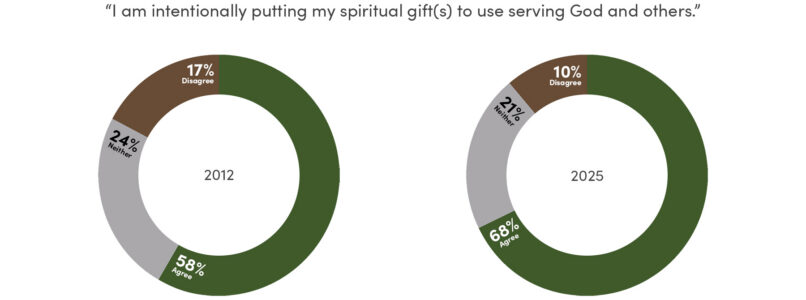
Around 2 in 3 U.S. Protestant churchgoers (68%) say they are intentionally putting their spiritual gift or gifts to use serving God and others, including 29% who strongly agree. One in 5 (21%) aren’t sure, and 10% say that’s not something they do. That highlights an increase in spiritual gift usage compared to a 2012 Lifeway Research study, when 58% of churchgoers purposely put their spiritual gifts to use and 17% disagreed.
“These self-evaluations of serving are definitely more yes than no but also more partial agreement than full agreement,” said McConnell. “Sharing the work of ministry with people who have different gifts is incredibly effective when all participate. But partial or inconsistent service weakens that person’s contribution to the congregation’s work.”
Another way churchgoers look to serve God and others is by being proactively forgiving. Almost 4 in 5 churchgoers (79%) say they forgive others regardless of whether they ask for forgiveness, including 39% who strongly agree. Few say they aren’t sure (14%) or aren’t forgiving in that way (7%).
As churchgoers think about serving others, they aren’t limiting their focus to their congregation. They say they are looking for ways to meet the needs of those in their communities.
Four in 5 U.S. Protestant churchgoers (80%) care for strangers, including 35% who strongly agree. Few aren’t sure (16%) or disagree (4%).
Churchgoers say they work to be proactive in serving others. More than 2 in 3 (68%) say they regularly find themselves meeting a need without being asked, including 25% who strongly agree. A quarter (25%) neither agree nor disagree, while 7% disagree.
Two in 3 (67%) regularly use their gifts and talents to serve or help people in need who are not part of their church, with 27% who strongly agree. Fewer aren’t sure (21%) or disagree (12%).
Specifically, almost 2 in 3 (64%) churchgoers intentionally try to serve people outside of their church who have tangible needs, while a quarter neither agree nor disagree (24%) and 11% say that’s not part of their practice.
This has consistently been a part of the way most churchgoers live out their faith. In 2012, 60% said they intentionally served those outside their church who had tangible needs. Similarly, in a 2019 Lifeway Research study, 62% said they did so.
“A distinctive teaching of Christianity relates to serving,” said McConnell. “Salvation is shown to come from the kindness and grace of God through faith in Jesus Christ, not by a person’s good works. Yet Paul says believers are ‘created in Christ Jesus for good works’ (Ephesians 2:10, CSB). Good news people should be diligent in good works.”