Month: August 2025

Churches help local public schools in a variety of ways, survey shows

BRENTWOOD, Tenn.—As students head back to the classroom, they’re likely to see the impact of local churches in their schools this year.

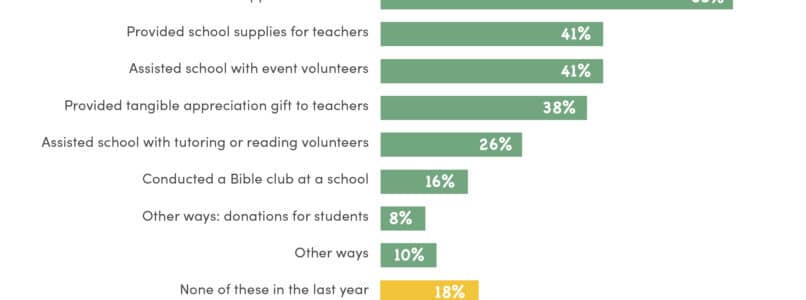
According to a Lifeway Research study, 4 in 5 U.S. Protestant pastors identify at least one way their congregations have engaged with local public schools in the last year. Only 18% of churches say they weren’t involved with area schools. The average congregation connected with schools in more than two ways.

“Every community has public schools, and the opportunities to serve them vary,” said Scott McConnell, executive director of Lifeway Research. “There are opportunities for churches to provide volunteer labor, help needy families or just thank those investing in the next generation.”

Learning to help

Most Protestant pastors (65%) say their churches provided school supplies for students in the last year. Around 2 in 5 provided supplies for teachers (41%), assisted a school with volunteers for events they conduct (41%) or provided tangible appreciation to teachers at a school, such as gifts, food, cards, etc. (38%). A quarter (26%) assisted the school with volunteers for their tutoring or reading program. Around 1 in 6 (16%) conducted a Bible club at a school.

Churches also said they helped a local school in the last year in other ways, including 8% who said they donated something to students, like clothing, food, scholarships, etc. One in 10 pastors (10%) specified another form of assistance as a way they’ve helped, including allowing the school to use their facilities, providing enrichment events for students in the summer and praying for teachers.

“At a time of year when churches are kicking off many of their own activities, it’s noteworthy that so many churches are making time to donate supplies for students and teachers and committing to serve their local public schools in other ways,” McConnell said.

A+ assistance

Different types of churches are more likely to help local schools in different ways. Generally, however, larger congregations with additional people and resources are more likely to engage area schools.

Churches with 250 or more in worship attendance are the most likely to say they have provided school supplies for students (80%), provided tangible appreciation gifts for teachers (63%), assisted with volunteers for school events (62%), provided supplies for teachers (58%), assisted with volunteers for tutoring or reading programs (43%) and conducted a Bible club at a school (38%).

Congregations of fewer than 50 are statistically the least likely to engage their local schools in any of those ways except conducting a Bible club. They are also most likely to say they haven’t helped a school in the last year (25%).

“Helping schools requires resources in the form of volunteer hours or donations. Larger churches have been given more resources, and they are applying them to serving their local schools,” McConnell said.

Churches in the South are also more likely to be engaged with their local schools. Pastors in this region are the most likely to provide school supplies for students (74%), provide supplies for teachers (56%) and provide tangible appreciation gifts for teachers (52%). Southern churches are also among the most likely to assist with volunteers for school events (47%) and provide volunteers for tutoring and reading programs (31%).

African American pastors are the most likely to say they have provided school supplies for students (80%) and are among the most likely to assist with tutoring or reading volunteers (41%).

Mainline churches are more likely than evangelical congregations to say they have provided school supplies for students (76% vs. 62%) and provided supplies for teachers (47% vs. 39%). Evangelical pastors are more likely to say they have conducted a Bible club in a school (20% vs. 11%).

Who are the unseen servants in your church?

Editor’s note: The following was adapted from Hance Dilbeck’s recent book, A Psalm for Unseen Servants. All author proceeds from the book will benefit Mission:Dignity, a ministry of GuideStone that honors retirement-aged Southern Baptist ministers, workers, and widows struggling to meet basic needs through advocacy and financial assistance.

In the 2016 movie, Hidden Figures, we are introduced to three African American female mathematicians serving at NASA. During the peak of the space race between the U.S. and the former Soviet Union, these women served as the brains behind getting John Glenn into space, becoming the first man to orbit the Earth, and bringing him safely home. They work diligently to help ensure NASA’s success in the 1960s, in fact. Sadly, most of us were unaware of their vital contributions for a half-century.

These human computers—Dorothy Vaughan, Mary Jackson, and Katherine Gobels Johnson—played an important role in the space race that ultimately led to the U.S. being the first to land a man safely on the moon and bring him back to Earth. Despite the racial challenges and hostility of that turbulent decade, they worked tirelessly to contribute to the success of that space race.

Their role was vital, yet unseen. “Unseen” is not a synonym for unimportant or unworthy.

When you go to the movies, do you ever sit in the theater to watch the credits? There are incredible stars who shine on the silver screen whose names appear immediately after the closing scene, but they could not exhibit their acting gifts were it not for the hundreds of men and women behind the scenes. Camera operators, sound technicians, extras, costume designers, directors, composers, editors, photographers, producers, writers, production managers, stunt doubles, choreographers, artists, composers, publishers, and even accountants and lawyers. These all get their names in the credits.

Why? Well, even though they’re unseen, that two-hour movie could not happen without them. While there may have been a handful of key actors, their work never would have been on the screen without the dedication of people who labor unseen.

The same is true for your church and mine.

When most members talk about a church service, they primarily think of the pastor and worship leader. They might consider an age-graded minister (children’s director or youth minister, for example). But if your church is one of size, Sunday morning worship relies on a host of people in the background—volunteers, of course, but also paid staff who serve behind the bright lights. They are often unnoticed unless there is a problem.

Most weeks, they serve unseen.

When I was a seminary student, I served a small, rural congregation in Oklahoma as their pastor. My wife and I were in our early 20s, and we lived in the parsonage next to the church. Our first son was just old enough to walk from the parsonage to church. Our lives were busy. She worked as a nurse nearby to keep food on the table while I commuted to Southwestern Baptist Theological Seminary in Fort Worth to study three days a week. Most Saturday afternoons and early evenings, I found myself in my study at the church preparing for Sunday worship.

On Saturdays, only one other person was in the church building: Harold. Harold had retired from Dallas to a lake nearby. He was an active member of our little church and had agreed to be the custodian. We paid him a small amount each week, and he gave us far more than our money’s worth.

While I wrote my sermon and used a typewriter to create the Sunday order of service (yes, a typewriter—I am that old!), Harold set up chairs, vacuumed the carpet, and cleaned the bathrooms. His last task was very important. He spent a considerable amount of time cleaning the front door of the church, a glass door. Harold was meticulous when it came to that door. He wanted everyone who walked in the next morning to know that he had done his job. He felt it reflected properly on the importance of the entire gathering.

Well, Harold had a problem—the pastor’s firstborn son! When I stayed too late on Saturday, my son would toddle over to tell me it was time to come home. When he did, before his mother could intervene, he would invariably reach up and put his hand on that clean glass door. Now, Harold’s masterpiece was ruined with a handprint. It may have been a cute little handprint, but the culprit was obvious.

I can still see Harold’s smile in my mind’s eye. He would pat the preacher’s kid on the head and go to find his glass cleaner.

I have deep respect for Mr. Harold. Even as I write these words, I recall his hard work, as unto the Lord. He served well. He served in a vital role. And few people ever seemed to notice him even though he made sure our members had a clean, stocked, and sanitary place to gather in worship to the Lord.

These unseen servants can be found supporting every local church and Christian ministry. They are often unnoticed, in fact, most of them prefer to be out of the spotlight. They are too often unappreciated as their faithful work is taken for granted. Other times, it is forgotten.

I wrote A Psalm for Unseen Servants to honor for men and women like him.

Praising the Lord, making a difference

This year, I had the pleasure of attending the Southern Baptist Convention Annual Meeting for the first time.

I have to admit—prior to the convention, most of my exposure to the annual meeting had been influenced by the negative attention it sometimes gets. But I’m thankful God has placed men in my life over the years who helped dispel some of my preconceptions.

The late Mike Smith once said to me, “It’s like a big family reunion where I get to see all of my brothers and sisters in Christ,” and I was pleasantly surprised to see he was right. This reunion included my former youth minister and current executive director of the Southern Baptists of Texas Convention, Nathan Lorick, and my favorite Bible teacher on the planet, John Yates from Faith Bible Institute.

The scope of how large this event is hit me like a train when I first entered the auditorium of the Kay Bailey Hutchison Convention Center in Dallas and praised the Lord alongside 18,000 other Southern Baptists. Just the sound of so many voices lifting up the name of Jesus in unison is an experience that left me in awe of how majestic a Savior we praise.

The exhibit hall was packed with booths and representatives from colleges, businesses, and ministries—all of which had tons of helpful information. I received materials, books, bags (thanks North American Mission Board!), pens, cards, and perhaps most importantly, ideas for some improvements I can try while ministering at my own church.

Clint Pressley, a North Carolina pastor who was elected to a second term as SBC president, gave an outstanding message and moderated the business incredibly well. He was humorous, bold, and emphasized the importance of the SBC and the work we participate in together.

The reports from NAMB and the International Mission Board were not only a joy to hear, but a reminder of the importance of our cooperative giving. Introductions via video from more than 50 missionaries were played for us to see. Many of those missionaries’ identities were hidden, providing a sobering reminder that some risk their lives to deliver the gospel of Jesus Christ to a lost and dying world.

While the business conducted at this meeting is an important part of the convention, I was surprised at how much more I enjoyed the worship and fellowship aspects, which were edifying and refreshing to me. I found it as true at SBC as my wife and I do at the SBTC’s annual Equip and Empower conferences that we try to attend each year—times we use to get away and be refreshed, renewed, and, most importantly to us, to spend some extra, deliberate time focusing on God.

While much of what I voted for at SBC turned out differently than I would have hoped, I still participated in the business of the convention and was glad to do so. While it could have been potentially disheartening for me to see votes not go my way, it wasn’t—the fellowship and brotherly love I experienced over those few short days overshadowed everything else.

This was a good lesson for me as our SBTC Annual Meeting nears in October. Here’s what I’ve learned: We all play a major part, and the future direction of our state and national conventions depends heavily on participation from each and every one of us.