Author: amadmin

Traveling the world

People love to travel. Part of the allure of doing something adventurous like joining the Navy, becoming a flight attendant or working as a crew member on a cruise ship is that you get to see the world. 

A half-century ago I was a high school student in Korea when I first traveled by air from my hometown of Daegu to the capital city of Seoul. Until then I had never been to the airport. I was amazed to see so many airplanes lined up next to one another!

Since that initial experience, I have traveled to more than 70 countries by air or sea. In a number of trips as a trustee of the International Mission Board from 1996-2006, I had the wonderful privilege of meeting with missionaries across the globe—to pray, to listen, to encourage and to have fellowship with them. I am grateful to God that they were being used to spread the gospel of our Lord Jesus Christ.

All those international trips opened my eyes to see how God has been working through Southern Baptists and through the faithful giving of our churches to the Cooperative Program. The fruit of all that travel was not limited to meeting new people and expanding my perspective of the world; it allowed me to come back with a renewed perspective of myself and my home mission field.

God’s plan of redemption is for his children to travel throughout the world in obedience to the Great Commission. God called Abraham to be a missionary when he was 75 years-old. He had to travel on foot from his hometown to an unknown destination (Genesis 12:1-9; Hebrews 11:8-10). Through his obedience, he became the father of many nations. Abraham was a pioneer missionary and the unknown land became the Promised Land for his descendants (Psalm 122:6-9, 147:2; Isaiah 65:17-25; Zechariah 14:11). 

In his heart for the world, God sent his only son Jesus as a missionary to this sinful world (John 3:16, 20:21). Sin entered this world when Adam and Eve disobeyed God’s command (Genesis 3:1-19; Romans 5:12-17). The only way to save mankind from the bondage of sin is God’s plan of salvation, in which Jesus died on the cross (Romans 3:23-26, 6:23; 1 Corinthians 1:18-25, 2:1-5; Ephesians 2:1-10; 2 Timothy 2:8-13; Hebrews 9:27-28).

When we repent and believe in Christ’s saving work on the cross, we automatically become his missionaries with a commission to be his witnesses to ends of the earth (Matthew 28:19-20; Acts 1:8).

God has a gift for the world—the free gift of salvation through the planting of the seeds of faith and the labor of reaping the harvest by the church. He called Saul, the persecutor of the church, to become a missionary for the purpose of planting churches (Acts 9:4-9, 9:15-18, 13:1-5). As the apostle Paul, he traveled all over Asia Minor and even to Europe to preach Christ and the message of the resurrected Jesus to the Gentiles. He planted many churches along the way so that through the church, all mankind will come to a saving knowledge of the Lord.

May we catch the missionary vision of our Lord for this world by expanding our hearts in both the act of going and giving (Acts 28:30-31; 2 Timothy 4:6-8). Not only will you benefit the mission field abroad, but you will gain a deeper understanding of yourself, your home mission and the heart of God.  

—Paul Kim is the Asian-American relations consultant with the Southern Baptist Convention’s Executive Committee and pastor emeritus of Antioch Baptist Church in Cambridge, Mass.
Christ, the firstfruits of our resurrection

“But in fact Christ has been raised from the dead, the firstfruits of those who have fallen asleep” (1 Corinthians 15:20).

God has put eternity in the human heart (Ecclesiastes 3:11). It’s no wonder, then, that we all have questions about life after death. But what do people believe about the afterlife? Atheists believe this life is all there is. If that’s the case, then we should eat, drink and be merry, for tomorrow we die. Yet most people in the world believe in an afterlife. While the religions of the world hold to some kind of heaven or paradise or ultimate reality, those who hold to Eastern views likely believe in reincarnation: a seemingly endless cycle of incarnations until one is finally united with ultimate (spiritual) reality. 

Because God has put eternity in our hearts, we know that this life is not all there is. Christianity teaches that every person is born a sinner and deserves God’s judgment, which is death. But Christ lived a life pleasing to the Father and died on the cross in order to take the penalty for sin that we all owe. On the third day, God raised Jesus from the dead, showing that he accepted Jesus’ life and death as a substitute life and death for all who believe in Jesus. Through Christ, and only through Christ, all who believe have the hope of eternal life with God.

This month our churches will gather to celebrate the living hope that we have in Jesus. Our hope is that all who believe in him will also experience a resurrection from the dead, a physical resurrection to eternal life with the triune God. This is what the Old Testament taught (Daniel 12:1-3); this is what Jesus taught (John 5:25-29); and this is what the Jews believed (John 11:23-26). Apparently, some Corinthians denied the reality of the resurrection of the dead (1 Corinthians 15:12). They did not deny the afterlife altogether; they simply denied a physical afterlife. They had no place for a resurrected body. It is this denial that Paul addresses in 1 Corinthians 15. As we prepare for Easter this month, let’s remind ourselves of the hope we have in Christ, and let’s prepare ourselves to answer skeptics’ questions about resurrection, both Jesus’ and ours.

If you deny the resurrection of the dead, then by consequence, you deny Jesus’ resurrection (1 Corinthians 15:1-19). Paul’s basic argument: If Christ is being preached as raised from the dead, and if you (Corinthians) embraced this gospel, then how can you deny the resurrection of the dead (15:12)? Paul preached the resurrection of Christ as essential to the gospel (15:1-11). To deny the resurrection of the dead is to deny the resurrection of Christ because Christ’s resurrection is the basis for ours. If Christ has not been raised, then there is no hope for the living. We are still in our sins; there is no forgiveness; the gospel and our faith are without basis (15:14-17). Further, if Christ has not been raised, there is no hope for the dead; their bodies are in the ground decaying and nothing more (15:18). If Christ has not been raised, then Christians are the most pitiful people on earth (15:19).

But in fact Christ has been raised, and his resurrection guarantees ours (15:20-28). By faith in Christ we are united with him in his death, burial and resurrection (15:20-22; cf. Romans 6:1-11). Just as our union with the first Adam brings death, so our union with the last Adam brings life. But everything happens in its own order: Christ, the firstfruits of the harvest, then at his coming, the full harvest to come—the resurrection of the dead (15:20, 23). Jesus’ first coming inaugurated the kingdom, the beginning of his reign (15:25-27). At that time Jesus crushed Satan (Genesis 3:15), accomplishing forgiveness of sin for those who believe (Colossians 2:15). Now, Jesus is ruling Lord, crushing his enemies under his feet (Hebrews 2:5-9). When Jesus returns, then comes the end, the final resurrection when death will be defeated (1 Corinthians 15:24, 26, 28, 54-57).

Since Christ has been raised, we have hope! Therefore, until Christ returns we must live consistently with the knowledge of Jesus’ resurrection (15:29). As we await the redemption of our bodies (Romans 8:23), our lives must declare this hope!  

  • With the hope of the resurrection, we know that to die is gain (Philippians 1:21). Consequently, we will not fear death, for Christ has defeated sin and death and Satan (Hebrews 2:14-18).
  • With the hope of the resurrection, we know that to live is Christ (Philippians 1:21). Our lives have meaning and purpose in Christ. We will not sit idly by and await the return of Christ. We will be willing to suffer for the sake of the gospel (1 Corinthians 15:30-32; Philippians 3:7-11). We will press on in pursuing holiness so as not to be ashamed on that day (1 Corinthians 15:33-34; Philippians 3:12-21). And we will call all people to repent and believe in the Lord Jesus that they too may share in our hope. What does your life say about what you believe concerning the resurrection of the dead? As you celebrate the resurrection of our Lord Jesus Christ this Easter, know that we can look forward with hope to our own resurrection and eternal life with God. Lord Jesus, come quickly! 

Ronnie Yarber on the SBTC”s formation: “We were without a place”

Editor’s note: As the SBTC continues in its 21st year, we are sharing reflections from those who laid the groundwork for a new state convention. The TEXAN interviewed Ronnie Yarber for this article, the fourth of a series.

ATHENS  Ronnie Yarber knows what it is to be a man without a theological “country.”

For Yarber, the first official employee of the fledgling Southern Baptists of Texas Convention, the issues of the inerrancy of Scripture and definition of the Cooperative Program were among the most pressing differences propelling the new group to break off from the Baptist General Convention of Texas in 1998.

“When changes began to happen in Texas because of the Conservative Resurgence, we [Texas Baptist conservatives] were like a people without a country. We were without a place,” Yarber told the TEXAN.

Yarber became the administrative director of what he called “a little protest group” that tried to persuade BGCT leaders to move to a more conservative doctrinal stance.

“The little band of protesters grew,” Yarber said, as the BGCT redefined the Cooperative Program—Southern Baptists’ shared missions funding mechanism—in 1994, diverging from the national Southern Baptist Convention.

Yarber was among five conservative leaders asked to meet with five from the BGCT at Love Field in February 1998 to see if the differences could be resolved without a split.

“All 10 men agreed by the end of the second day of meetings that we were not on the same page. We probably would not be able to work together,” Yarber said, explaining that in addition to biblical inerrancy and the nature of CP giving, the groups had different perspectives on abortion, homosexuality and the ordination of women as senior pastors.

“Regarding inerrancy, [conservatives] had the Chicago Statement on Biblical Inerrancy to go by,” Yarber said, referring to the landmark document issued 40 years ago by the International Council on Biblical Inerrancy. 

Conservatives objected to the ordination of a practicing homosexual deacon at Austin’s University Baptist, a church then affiliated with the BGCT. They also disagreed with the BGCT’s adoption of its Christian Life Commission’s statement on abortion, which noted five “regrettable” exceptions where abortion could be morally acceptable. Finally, the BGCT’s stance on female senior pastors was at odds with conservative views, Yarber said.

Another divisive issue was the BGCT’s continued financial support of the increasingly liberal Baptist Joint Committee on Public Affairs after its funding was discontinued by the national SBC. 

Yarber recalled a pamphlet distributed by the Baptist Joint Committee to Southern Baptist pastors, the topic of which was “how to overthrow the religious right in your community.” The publication alarmed Yarber, who perceived an attack against theological conservatives who saw key moral issues as having political implications. 

“It was pretty intense,” Yarber recalled of the Love Field meetings, adding that all participants prayed together and shook hands at the end of the two days.

On Nov. 19, 1998, the SBTC was constituted in Houston.

“I’ve never been angry. I was disappointed in what could have happened in Texas,” Yarber mused of the separation from the BGCT.

Yarber called the selection of Jim Richards as the new convention’s first executive director “the most major and wise decision” the SBTC made.

Yarber, then also pastor of Mesquite’s Meadow Creek Community Church (formerly Gross Road Baptist), served in multiple roles in the SBTC’s early days and maintains involvement today.

“I was Jim Richards’ assistant, then interim director of the evangelism department, interim director of the pastor-church relations department, interim editor of the newspaper [The Plumbline, forerunner to the TEXAN] and chief financial officer,” Yarber said.

He liked it all except for the CFO designation, explaining that he would take deposits to the bank at the end of each day. “I don’t crunch numbers. Numbers crunch me,” Yarber said with a laugh. 

Of the SBTC’s initial budget of $903,000 approved by messengers of 120 churches in 1998, Yarber said he and Richards both thought the number “absurd.”

“Where is this going to come from?” Yarber remembered Richards asking.

“Who knows?” Yarber answered.

But the funds did come, and the new convention maintained its resolve to give at least half to the Cooperative Program of the SBC. The SBTC’s current practice of sending 55 percent of undesignated CP receipts on to the national convention makes it the highest CP-giving state convention by percentage.

“We stay near the top of all state conventions in total giving, too,” Yarber said. “Did the national CP lose money when the SBTC formed? I think not.”

Today, Yarber and his wife of 59 years, Carol, live on farmland 10 miles from Athens. Yarber continues his work with the SBTC, visiting with churches that express interest in affiliating with the convention.

He estimates that he has conducted just shy of 1,000 informational meetings for churches and groups of churches since 1998, including three in late February and early March.

Yarber said he does not try to persuade a church to leave one convention for another, or even to opt for dual affiliation.

“Do not split your church over the question,” he advises pastors. 

As for Carol, “she has been a jewel” and a “prayer warrior,” Yarber said, adding, “I listen to her when she speaks. I know she walks with the Lord. I’d be a fool not to listen to her. She’s been my blessed help.”

REVIEW: “Unplanned” is a rated R film you should see

Abby is an outgoing and friendly college student who is still uncertain what she believes about life — literally and figuratively.

Thus, when a Planned Parenthood worker at a university event asks if she’s interested in volunteering at the clinic, Abby barely hesitates. Yes, her parents won’t approve, but Abby wants to help women.

Her task: escort the patients from the parking lot to the front doors, shielding them from the pro-life protesters.

Abby — it turns out — enjoys it. She’s making a difference. She’s protecting women. At least, that’s what she tells herself.

Pretty soon, Abby’s role transitions from volunteer to paid employee. And eventually, she becomes clinic director.

Her pro-life Christian parents hate her job, but she doesn’t care. Besides, there are religious people in the pro-choice community, too.    

“I don’t care what anyone says,” a co-worker says. “I am doing God’s work here.”

But then Abby is asked to help with an abortion. And then she witnesses, first-hand, the moral horrors it entails. And then she begins having doubts about her beliefs on abortion.

The film Unplanned (R) opens in theaters March 29, telling the unlikely true story of Abby Johnson, a former Planned Parenthood director who quit her job to become a pro-life advocate.

It stars Ashley Bratcher (90 Minutes In Heaven) as Abby; Jared Lotz as Shawn, a pro-life worker with 40 Days for Life; and Emma Elle Roberts (I’m Not Ashamed) as Marilisa, another worker with 40 Days for Life.

The film begins with the pivotal abortion scene but then jumps back eight years to her college days, showing how she climbed the ranks to become clinic director.

Its filmmakers were aiming for a PG-13 rating but got stuck with an R — an undeserved rating that can only be described as one of the worst decisions in the history of the ratings board. The R is for “some disturbing/bloody images.” Yet broadcast television regularly exceeds the disturbing and bloody content of Unplanned — as does every PG-13 superhero film in the last decade. (More on that in a moment.)

Despite the rating, Unplanned is appropriate for teens and mature tweens.

Warning: minor/moderate spoilers!

(Scale key: none, minimal, moderate, extreme)

Violence/Disturbing

Moderate. The film deals with the subject of abortion, but it never shows an abortion from the perspective of the doctor, even though we are in the room. We see an abortion take place on a computer screen (a sonogram), as the small baby is in the picture one instance and gone the next. We see a clothed woman sitting on a toilet, blood dripping off the seat. She steps in the shower (still clothed) with blood dripping down her leg. She picks up a bloody blob off the floor and puts in in the toilet (presumably it was the small baby). In another scene, a father pressures a teen girl to have an abortion; there are complications in the room but she survives. Still another scene shows pieces of an aborted baby on a table. All total, these scenes last perhaps five to 10 minutes. Most of the movie focuses on Abby’s journey.

Sexuality/Sensuality/Nudity

Minimal. Two people kiss.

Coarse Language

Minimal. H-ll (2), d–nit (2), a– (1).

Other Positive Elements

The film contrasts the peaceful, prayer-filled protests of 40 Days for Purpose (Shawn and Marilisa) with that of protesters who are screaming unkind words toward the women. It’s obvious which strategy works best.

Abby’s pro-life parents accept and love her unconditionally, even if they strongly disagree with her job.  

Life Lessons

Unplanned gives us lessons on patience and prayer (Shawn and Marilisa, Abby’s parents), blindness to sin (Abby), and unconditional love (Abby’s parents and husband).

Worldview/Application

There have been more than 60 million abortions since the 1973 Roe v. Wade decision legalized the procedure nationwide. And despite the best efforts of pro-lifers, roughly half the country still considers itself pro-life. Why?

Perhaps Americans are just like Abby Johnson once was. Maybe they are pro-choice because they never have to think about abortion. They never have to watch an abortion. They never have to consider the ramifications of their stance. It takes place in a private clinic, in a private room, behind closed doors.

This doesn’t mean it’s necessary to watch an abortion to transition from pro-choice to pro-life. But it does mean that when we consider what abortion is and what it involves, we are faced with a moral choice that many people would rather avoid.

What Works

The interaction between Abby and the pro-lifers. The screenplay and the film’s structure. It makes for a gripping story. The movie’s final 30 minutes is emotion-laden and well done. It ends on a high note.

What Doesn’t

One or two scenes are over the top and could be viewed as propaganda by the pro-choice community.

Discussion Questions

  1. What does the Bible say about the unborn? (See Psalm 139, Jeremiah 1:5.)
  2. What did the first Christians think about abortion? (Google the “Didache and abortion.”)
  3. What led Abby to change her mind about abortion? Do you think there are other people like Abby in our society?
  4. Did the film change how you view abortion and Planned Parenthood? Explain.

Entertainment rating: 3.5 out of 5 stars. Family-friendly rating: 3.5 out of 5 stars.

Rated R for some disturbing/bloody images.

New SWBTS president aims to reinvigorate scholarship, missions and evangelism

FORT WORTH  Adam Greenway says he wants to continue Southwestern Baptist Theological Seminary’s legacy as the “big-tent seminary of the SBC,” where Southern Baptists who differ on secondary theological issues can unite behind rigorous scholarship, missions and evangelism.

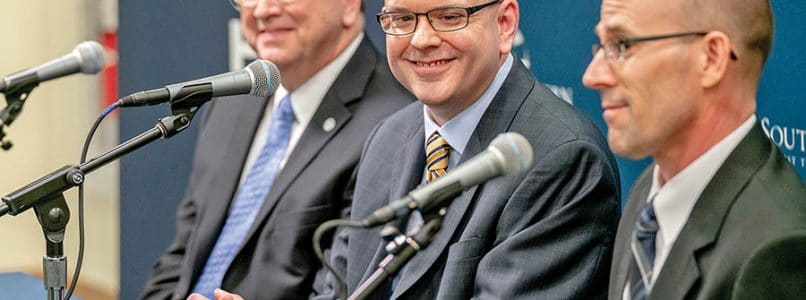
Greenway laid out his vision at a Feb. 27 press conference following his election as Southwestern’s ninth president. He also spoke of continuing the seminary’s heritage of strong faculty and producing Southern Baptist Convention leaders. Greenway said he has “no intention” of “trying to create a miniaturized version of Southern [Baptist Theological Seminary]” where he served as a dean the past six years.

“Southwestern has had a distinct heritage … of being the big-tent seminary of the SBC,” Greenway said, “the seminary that’s been able to bring people together who may have differences of opinion on secondary or tertiary matters, but are committed to the main things of the Great Commission, the local church, missions, evangelism, preaching [and] pastoral ministry.”

Southwestern is unique for its “scholarship on fire” focus, Greenway said, quoting a phrase Southwestern founder B.H. Carroll used to describe academic rigor combined with passion for Christ. The seminary established the first professorship of evangelism at any seminary in North America, has been known for its soul winning emphasis and is poised to “touch the world and impact eternity right here from Seminary Hill.”

Another part of Southwestern’s heritage Greenway said he hopes to continue is its production of denominational leaders for churches and SBC entities. He noted Southwestern President L.R. Scarborough’s leadership in the SBC’s 75 Million Campaign nearly a century ago as well as Southwestern alumni who have influenced the SBC more recently, including Jimmy Draper, Morris Chapman, Jerry Rankin, Jack Graham and O.S. Hawkins.

Southwestern should “continue to provide a pipeline for leadership in every aspect of convention life,” Greenway said.

Maintaining a “faculty of generals” who attract the next generation of ministers will be another hallmark of Greenway’s tenure, he said.

In response to a media question, Greenway said he will not attempt to make Southwestern like Southern. The two institutions are distinct in Southern Baptist life and have a relationship analogous to Harvard and Yale, Greenway said.

“I have no intention of trying to come and trying to create a miniaturized version of Southern or a caricature of Southern here,” Greenway said. “I do not believe that Southwestern needs to import another institution’s legacy. We simply need to reinvigorate and retell the great legacy and history of this seminary for a new generation.”

Appearing alongside Greenway, Southwestern trustee chairman Kevin Ueckert and Southwestern presidential search committee chairman Danny Roberts said they believe Greenway is God’s man to lead Southwestern forward.

“God has provided us all a unique blessing to be part of a moment like this,” said Ueckert, pastor of First Baptist Church in Georgetown, Texas. “And it’s our belief that this is the beginning of many more moments of sensing the Lord’s work, his presence and his purpose.”

Roberts, executive pastor of North Richland Hills Baptist Church, said “God opened the paths that we needed to go down” during the search process. “It was absolutely incredibly amazing how the Holy Spirit worked in and through each of the different times we met together.”  

REVIEW “Apollo 11” is a splendid celebration of achievement and God”s creation

Apollo 11’s mission to the moon was among the greatest achievements in world history, but — sadly — it wasn’t captured with today’s high-definition video cameras.

Instead, we’re left only with grainy footage showing Neil Armstrong stepping on the moon and Walter Cronkite describing the action.

Then again … maybe not.

A new documentary, appropriately named Apollo 11 (G), brings that 50-year-old mission to life thanks to a newly discovered batch of 65mm film and more than 11,000 hours of uncatalogued audio recordings — most of which we’ve never seen or heard.

The result is a 90-minute movie that nearly has the appearance of being filmed yesterday and makes you feel like you’re living in 1969.

It’s among the best documentaries I’ve seen and — minus two moments of coarse language — is squeaky-clean for the entire family.

It was directed and edited by Todd Douglas Miller, who is best known for his work on another documentary, Dinosaur 13. He said he wanted to avoid using the footage the public already had seen.

“I’m such a fan of space films, and when we started this project, I was seeing everything again ad nauseum, so I knew what was out there,” he told the entertainment site MoveableFest.com.

Miller succeeded in his quest. For example, the iconic black-and-white film of Armstrong stepping down the ladder isn’t even in the movie. Instead, we watch a color film that was recorded inside the lunar lander by his crewmate, Buzz Aldrin.

The rest of Apollo 11 follows a similar pattern, as we enjoy never-before-broadcast footage of event after event. Instead of grainy television footage of the launch, we’re treated to an up-close 65mm footage of the rocket lifting from the pad and piercing the clouds. That alone is worth the price of admission.  

The movie also succeeds because it has no narrator. We only hear the astronauts, the Mission Control workers, and, of course, Cronkite. His booming, nostalgic voice sets the tone.

“It’s three hours and 32 minutes until man begins the greatest adventure in his history,” Cronkite says at the beginning “If all goes well, Apollo 11 astronauts Armstrong, Aldrin and Collins are to lift off from pad 39A out there, on the voyage man has always dreamed about.”

At the beginning of the movie, we watch the mammoth Saturn V rocket make its way to the launchpad on the crawler-transporter. Later, we see the astronauts donning their suits and climbing into the capsule. The movie ends with the world celebrating their return.

Yet it’s the miniscule details, recorded on once-forgotten footage the day of the launch, that makes the documentary entertaining: Americans drinking coffee on the beach, lining up at concession stands, waking up in a Florida campground, and cramming together on a hotel balcony — all ready to see history being made. It happened when coffee was 5 cents, beehive hairstyles were in, and everyone wore crazy-looking glasses. (Yes, those details are in the film, too.)

Apollo 11 is a must-see film for those who lived through it and those who are just learning about it in school. It’s inspiring and educational, and it contains a few edge-of-your-seat moments you likely didn’t expect. It’s a celebration of achievement, teamwork and our shared humanity.

It also raises a few worldview questions, led by Buzz Aldrin’s pronouncement that the mission was a symbol of the “insatiable curiosity of all mankind to explore the unknown.” But why do we have this insatiable desire to explore? Perhaps it’s because God planted within us a hunger to discover what’s out there. Perhaps it’s because God’s universe is so incredible it’s worth exploring. Or perhaps it’s because we have the imago dei — the image of God — that gives us the ability to build rockets and learn more about what God’s creation.

Whatever the reason, Apollo 11 is worth watching.

Discussion questions

  1. Why do you think mankind has the desire to explore the unknown?
  2. Was the Apollo 11 mission worth the cost?
  3. What do you remember about Apollo 11? Where were you? (For children: Ask a parent or grandparent what they remember about the mission.)

Content warnings: The film contains no violence or sexuality and two coarse words (h-ll heard in the John Stewart song Mother Country, and a muffled “d–n” by Collins from space when he says he feel “d–n good.”

Entertainment rating: 4 out of 5 stars. Family-friendly rating: 4.5 out of 5 stars.

Apollo 11 is rated G.

School funding reform takes center stage in Texas Legislature

AUSTIN  With the introduction of two identical bills out of the Texas House and Senate, each earning the blessing of Gov. Greg Abbott, property tax reform promises to highlight debate during the 86th Session of the Texas Legislature. But the bills’ proposed property tax rate cap of 2.5 percent a year concerns some legislators who believe the cap could create shortfalls in local essential services and, particularly, school districts.

House Bill 2 and Senate Bill 2 reduce the amount a local taxing entity can raise rates each year from 8 percent to 2.5 percent. Voters must approve anything higher. Critics claim the lower rate supplants local control and hinders school districts from raising funds as needed. But revenues from the state’s thriving economy can offset anticipated local deficits, said Lt. Gov. Dan Patrick who, along with Abbott and Speaker of the House Dennis Bonnen, introduced the bills in a Jan. 31 press conference at the Capitol.

The long-promised property tax reform has become a more pressing need in recent years, said SB 2 author Sen. Paul Bettencourt, R-Houston, during the press conference. Property tax rates remained constant or even rose as property values have also gone up, hitting property owners twice on their tax bill, he said.

“The Senate and the House have agreed already we will be using billions of those dollars to support our local school districts,” said Bonnen, a Republican from Angleton.

But the legislative leadership failed to cite the specific revenue sources that would finance anticipated shortfalls caused by the 2.5 percent cap. And that concerned Democrat Rep. Trey Martinez Fischer of San Antonio and Eddie Rodriguez of East Austin.

While critical of the plan, they did not dismiss it out of hand during a press conference following the legislation rollout. In addition to concerns over school funding, Martinez said the cap would negatively impact city and county services, particularly first responders.

“This raises more questions than it does answers,” Martinez said. “I have made a commitment to the people I represent that there is nothing more important then making sure we leave this session with a responsible school finance plan that is going to tell the state to do its part.”

He thanked Bonnen for stating the plan requires input from the entire House, which Martinez noted includes 12 newly elected Democrats.

Rodriguez called the rate cap a “non-starter.

“I don’t see how we can look at a bill like this without understanding what school finance reform is going to look like,” he said. Without that information, discussion of the revenue cap “should slow down.”

Bipartisan cooperation will be essential in drafting legislation that will give property tax relief and meet the educational needs of all 1,247 Texas school districts, according to Sen. Larry Taylor, R-Friendswood and Sen. Eddie Lucio, D-Brownsville, the Senate Education Committee chairman and vice chairman, respectively. 

“As a state, our baseline measure of adequacy should be ensuring that the needs of all students are met,” Lucio said.

The senators’ districts in suburban Houston and the Rio Grande Valley represent the diverse socio-economic student population that make equitably funding local schools a challenge.

For decades the state’s school funding mechanism has been on trial. Property-rich school districts can raise—and spend—far more money than property-poor school districts, and that funding disparity creates educational inequity among Texas’ school children according to critics who have sought relief in court since 1983.

In a 2016 decision that essentially declared the funding system flawed but constitutional, the Texas Supreme Court, for now, removed itself from the debate. The Legislature, not the court, must determine what is equitable, they unanimously ruled.

“The Legislature was always reacting, essentially, to what the [Texas] Supreme Court was saying was necessary to make the system constitutional,” said Kara Belew, senior policy advisor at the Texas Public Policy Foundation.

This session marks the first time in decades the Legislature will draft school funding proposals without the court or a lawsuit dictating the content, Belew told the TEXAN. The governor’s 2.5 percent property tax cap is a “great start” but falls short of the TPPF’s end-game – eliminating nearly half of the property tax burden by ending the school maintenance and operations property tax.

“Ours is the only plan that genuinely lowers property taxes where you will see your bill go down from one year to the next. All of the other plans just slow down the growth tax,” she said.

The TPPF plan also employs a 2.5 percent per year rate cap and, using the state’s surplus revenue, pays down the local tax bill until it is eliminated over 10-12 years.

The revenue surplus comes from reduced spending, Belew said. Sales taxes generate the greatest source of revenue for the state, and in a booming economy that means more money in state coffers. The TPPF plan also relies on revenue generated from the Permian Basin oil reserves.

But in his January report on revenue estimates for 2020-21, Texas Comptroller Glenn Hegar warned that “any consideration of public education finance should recognize the higher inherent volatility of state revenue.

“The sales tax that supplies well over half of all state tax revenue is vulnerable to the effects of economic downturns,” he said. “Severance taxes are even more volatile, often varying by 50 percent or more annually.”

But building a surplus also comes from limited and reduced spending at the state level, Belew said.

Lucio, whose district includes some of Texas’s poorest counties, wants to ensure impartial education opportunities for all students, including proper funding for special education.

Despite different spending priorities—and the bitter political divide on the national front—Taylor said the “relationships across the aisle are quite congenial” at the Texas Capitol.

And their shared Christian faith guides their work.

“Legislators should take seriously God’s command to love one another, for how we treat others is a true test of our love for Christ,” Lucio said.

REVIEW: “Wonder Park” is a wonderful tale about joy during trials

June is a young girl with a big imagination and an even bigger smile.

Each day, she and her mother sit in June’s room and design an imaginary theme park that June “brings to life” through stuffed animals, boxes and colorful toys.

In June’s imagination, families visit a park called “Wonder Land” that is hosted by talking animals — Boomer the blue bear, Peanut the monkey and Steve the porcupine.

And when June asks for creative help from her mom, she gets a gentle rebuff.  

“I like it when the ideas come from you,” her mom says, smiling. “Now, think.”

Her make-believe theme park covers the room. Occasionally, she even designs a “real” outdoor roller coaster that stretches across the neighbors’ yards and attracts dozens of friends.  

For June, life couldn’t be better.

But then her mom gets deadly sick and has to visit the hospital. Sad and depressed, June packs her stuffed animals and toys into boxes and puts them away. Wonder Land, it seems, is closed for the season.

The animated movie Wonder Park (PG) opens in theaters this weekend, telling the story of a girl who loses her imagination when her favorite playmate — her mom — becomes ill. The film stars Jennifer Garner (Miracles From Heaven) as the mom, Brianna Denski as June, and Ken Hudson Campbell (Home Alone) as Boomer.

Wonder Park is a film that outperforms its trailer. No, it won’t be the best animated film of the year, but it includes positive messages not seen in most family films.

The animation is colorful and the funny moments truly funny. It’s also (mostly) void of potty humor. That always gets bonus points from me.

All of this makes up for a slightly disjointed plot.

Warning: Spoilers ahead!

(Scale key: none, minimal, moderate, extreme)

Violence/Disturbing

Minimal. June accidentally rides her real-life homemade roller coaster car through traffic. In her imagination, we see animals survive a few harrowing moments on a roller coaster ride. The film’s most disturbing scene involves hundreds of “Chimpanzombies” chasing her. They look like small harmless monkeys.

Sexuality/Sensuality/Nudity/Romance

None. One animal has a crush on another animal. At the end of the film, he gets a kiss on the cheek.

Coarse Language

None. An unfinished “son of a.” Three instances of “gosh.”

Other Positive Elements

June’s mom and dad are role model parents. They love her unconditionally. The dad also tells the mom that they’re not dating enough. June’s friends and family try cheering her up when her mom becomes ill.

Life Lessons

The film’s lessons can be understood only by revealing the plot. (Spoilers ahead!) After the mother becomes ill, June’s father sends her to summer math camp. But June runs away with the goal of hiking home through the woods. It is there that she discovers a run-down theme park called — you guessed it — Wonder Land. The animals tell her that the park was in operation until “the darkness” arrived. (The darkness is an eerie-looking swirling cloud in the sky.) June then works to bring Wonder Land back to life.

The symbolism is ripe. Wonder Land represents her imagination — perhaps even her joy — while “the darkness” represents everything that stole her joy. The darkness may even represent her.

The movie has multiple lessons: finding joy in the midst of tragedy, re-discovering your imagination, and encouraging others who are facing trials.

Worldview/Application

Wonder Park raises solid questions about tragedy, even if its answers are incomplete.

June says her mother would not want her to be sad. “She got sick … and I got scared — so scared of losing her that I lost myself. She would hate to see how I changed,” June says.

The movie, though, doesn’t give us a remedy. It’s impossible to find true hope during trials without the hope found in Scripture (Romans 5:2-5). Christians have hope during tragedy because they have an eternal perspective that the world cannot provide.    

Discussion Questions

  1. Have you ever experienced a trial that caused you to lose joy?
  2. What does the movie get right and wrong about finding joy during trials?
  3. What is the key to discovering joy during trials?

Entertainment rating: 3 out of 5 stars. Family-friendly rating: 4.5 out of 5 stars.

Rated PG for some mild thematic elements and action.

REVIEW: “Five Feet Apart” and the meaning of life

Stella is an energetic and optimist young woman living in a world where hopelessness abounds.

She has cystic fibrosis, a chronic disease that causes mucus to accumulate in her lungs. Her life expectancy is a few days, a few months or a few years. No one knows.

Her home is the hospital, where she patiently awaits a lung transplant while getting regular check-ups and closely following her drug regiment.

She vlogs about her condition. She also lives vicariously through her friends, who visit her often and video chat with her from locations she can’t go. They tell her about the things they do and the men they date.

But lately, Stella has had her own budding romance. It’s with Will, another cystic fibrosis patient who has a similar prognosis. In many ways, they’re polar opposites. Yet they bond over their common battle against a disease that could take their lives.

Can it last? And can they continue a romance while following a hospital rule that requires them to never sit close, hug or hold hands—much less kiss?

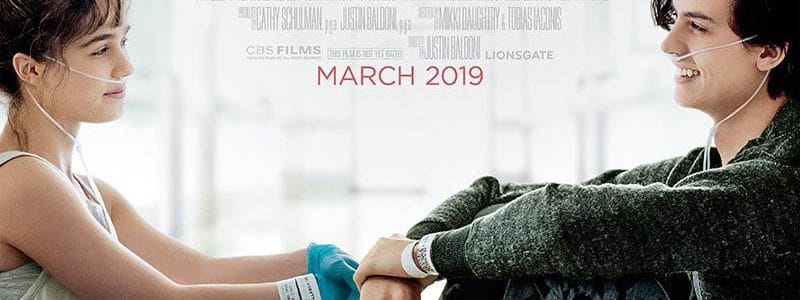
The romantic drama Five Feet Apart (PG-13) opens this weekend, telling the story of a couple who must decide if their love for one another is worth risking physical contact that could cost them their lives. The film gets its name from a hospital rule that cystic fibrosis patients must remain at least six feet apart to prevent cross-contamination. Stella and Will decide to cheat and stay five feet apart — or as Stella says, the length of a pool stick.

It stars Haley Lu Richardson (Split) as Stella, Cole Sprouse (Riverdale) as Will and Kimberly Hebert Gregory (Vice Principals) as their nurse, Barb.

The film succeeds as a romance—albeit, with some content concerns—while raising some of the most significant questions about life and death.

Warning: minor/moderate spoilers!

(Scale key: none, minimal, moderate, extreme)

Violence/Disturbing

Minimal/moderate. Patients spit up mucus. A character dies; we see a nurse performing CPR, and then we see people grieving. Death is discussed often.

Sexuality/Sensuality/Nudity

Moderate. The film has no nudity or bedroom scenes but does include basic discussions about sex (without detail). Stella and Will strip down to their underwear to show each other their scars. One cystic fibrosis patient, Poe, is gay. His dating relationships with other men is mentioned several times. He says he loves one of the guys.

Coarse Language

Moderate. S–t (11), OMG (5) d—n (3), misuse of “God” (2), a– (2), GD (1), f-word (1), b–ch (1).

Other Positive Elements

Stella’s friends are role models for how people should treat those with chronic diseases. They go out of their way to improve Stella’s life.

Life Lessons

The film’s opening scene shows a baby while emphasizing the importance of human touch — something we take for granted but something Stella and Will are unable to experience. Whether it’s a hug, a peck on the cheek or a pat on the back, we need human touch “almost as much as we need air to breath,” as the movie puts it. What would it be like not to be able to hug your family or friends? That’s the reality for Stella and Will.

Worldview/Application

If you had a chronic condition and knew you could die at any time, how would you live differently?

Stella and Will approach this question differently. She wants to follow the drug regiment perfectly, holding out hope for a cure. He is just the opposite and often skips doses. But neither is living life with the right balance. One thinks only about medicine. The other is careless about his life.

Finally, Stella sees the error in her ways: “This whole time I’ve been living for my treatments instead of doing my treatments so that I can live. I want to live.” Perhaps we should ask: Are we living life with joy? Or are we so busy that we’ve forgotten God’s many blessings and the simple pleasures of life?

The movie also encourages us not to fear death. Faith isn’t mentioned, but Stella believes in an afterlife. Will does not.

“I refuse to believe” there is no afterlife, she says.

As Christians, we can have the boldness to face death without fear (1 Thessalonians 4:13-18).

Discussion Questions

  1. Are you more like Stella or Will? Why?
  2. If you had only a few weeks to live, how would you live differently than you are now? Why aren’t you living that way right now?
  3. Why is human touch so important? How is it different from mere words?

Entertainment rating: 2.5 out of 5 stars. Family-friendly rating: 2.5 out of 5 stars.

Rated PG-13 for thematic elements, language and suggestive material.

Greenway elected 9th president of Southwestern Seminary

FORT WORTH—Adam W. Greenway has been elected the ninth president of Southwestern Baptist Theological Seminary. The election occurred during a special called meeting of the seminary’s board of trustees on the Southwestern campus, Feb. 26-27.

Trustees also elected Randy L. Stinson as provost and vice president for academic administration of Southwestern.

Greenway, 41, comes to Southwestern from Southern Baptist Theological Seminary in Louisville, Ky., where he served as dean of the Billy Graham School of Missions, Evangelism and Ministry. Greenway’s election signifies a return to Southwestern, as he completed his master of divinity on the Fort Worth campus in 2002. See related Baptist Press report.

Greenway was selected as a candidate by Southwestern’s presidential search committee, which was chaired by trustee Danny Roberts. Other members were Denise Ewing (Ill.), Jamie Green (At Large, search committee secretary), Guy Grimes (Calif.), Todd Houston (N.C.), Tom James (Ky.), Philip Levant (At Large), Andre Palmer (N.Y.), and Calvin Wittman (Colo.), search committee vice chair). Trustee chair Kevin Ueckert and vice chair Connie Hancock served on the committee ex officio.

During the special called meeting, Roberts recommended to the board that Greenway be elected president as well as professor of evangelism and apologetics. 

Trustee Bart Barber, speaking on behalf of the Academic Administration Committee, recommended Stinson, former senior vice president for academic administration and provost at Southern Seminary, for provost. 

The results of both votes weren’t made available to the public.

Prior to these elections, Ueckert, chairman of the board, thanked D. Jeffrey Bingham amidst a standing ovation for his leadership of the seminary during this academic year.

“No matter when our applause would have stopped, it would have been insufficient,” Ueckert said. “Dr. Bingham, you have been exemplary in your godliness, fearless in your leadership, and the greatest example for those who aspire to trust the Lord. We are grateful. In our seminary’s history, we will include a huge asterisk by your name to the significance of how you led us at a time where only God chose to use you.

“And as much as you will defer those accolades to those around you, I want it to be publicly known that the trustees of Southwestern Seminary believe that God uniquely used you in the most amazing way. And we are forever indebted. Thank you.”

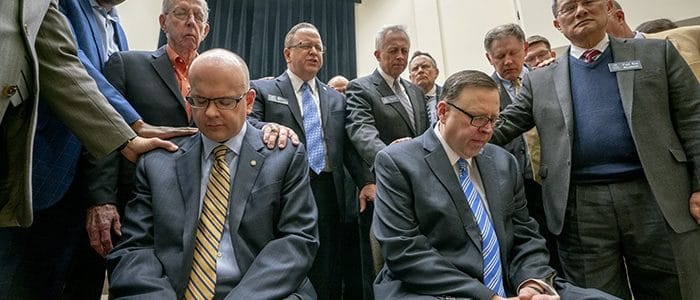
The meeting concluded with the board gathering around Greenway and Stinson for a time of prayer. Danny Roberts voiced the prayer on behalf of the board, asking for the Lord’s blessing upon Greenway and Stinson’s families and ministries, the Lord’s guidance through the coming months, and a bright future of Great Commission fulfillment by the Southwestern family.