Author: Russell Lightner

Is God’s hand on my ministry?

How do you know whether the hand of God is on your life and your ministry? I noticed Ezekiel often stated, “The hand of the Lord was upon me,” so I looked deeper to find out what God’s anointing looked like in his ministry.

1. Gifting for our call 

Ezekiel spoke of his call to become “a watchman over the house of Israel … the hand of the Lord was on me there” (Ezekiel 3:17). 

In addition to Ezekiel, Scripture likewise talks about the hand of God on Samson, Elijah, Elisha, and others who courageously answered His call. If the hand of God was on these men of God, why not also on our lives today? Is God not the same yesterday, today, and forever? God will anoint those He appoints, including you.

“God’s gracious gifts and calling are irrevocable” (Romans 11:29).

2. Spiritual fruit that lasts

When God puts His hand on our ministry, the Holy Spirit bears fruit, some of which is visible. Although numerical growth is not the only scorecard for church health and growth, conversion growth is. I believe there will be some evidence of kingdom growth in your ministry if God’s hand is on it. Without God’s hand on our ministry, we end up spinning our spiritual wheels in vain. 

“The one who remains in Me and I in him produces much fruit, because you can do nothing without Me” (John 15:5).

 3. Resilience in ministry

No church stays in revival mode, so some seasons are harder than others. Ezekiel had one of the toughest ministry assignments imaginable. He would much rather have preached more on deliverance than judgment, but he stayed true to his calling. Frankly, the weight of his ministry sometimes wore him out. Imagine your worst day on the front lines of ministry. That was a normal day for Ezekiel.

“I am sending you to the rebellious pagans … do not be afraid of them or their words or be discouraged by the look on their faces, for they are rebellious” (Ezekiel 2:6-7). 

I hear more about church revitalization than pastoral revitalization, yet is it plausible to have one without the other? With such a difficult and lonely ministry, Ezekiel needed the hand of God to hold him up when he got down. So do we sometimes.

God’s people had been in captivity and without the hand of God’s blessing for so long that they had lost their song. “How can we sing the song of the Lord in a strange land?” (Psalm 137:4). 

Not only did Israel lose its song, but Ezekiel lost his sermon. God would not let Ezekiel speak for a season. I’ve been there, and it’s not fun. However, when God put His hand on Ezekiel again, he preached with great power and unction.

“The hand of the Lord was upon me, and He opened my mouth. … So, my mouth was opened, and I was no longer silent” (Ezekiel 33:22). 

This can happen to you, too! Take God by the hand right now and ask Him to rekindle your call and anoint your life and ministry with spiritual fruit so you can serve well and finish well.

Memories of Harvey

I began seeing the news alerts Friday morning. It was the Fourth of July, and extensive flooding was sweeping across the Texas Hill Country. Many people were already reported missing, including little girls and counselors attending a Christian summer camp. 

Later that day, the reports became much graver, as the numbers of people reported missing were rising to a shocking level. By Saturday, it became clear: This was more than the occasional flooding we hear about from time to time. These floods were historic and deadly beyond anyone’s imagination.

My thoughts immediately turned to Hurricane Harvey.

In 2017, I was serving as the missions and evangelism pastor at First Baptist Church in Vidor, a rural town along Interstate 10 between Beaumont and the Louisiana border. Harvey barreled through that August, leaving in its wake one of the worst natural disasters in U.S. history.

I’d never seen it rain so hard for so long in my life. Vidor, like many towns in that region, was pounded with about 60 inches of rain in just a couple of days—still the largest amount of tropical storm rainfall recorded in the U.S. since such data began being tracked in the 1880s, according to the National Weather Service. Sixty percent of our town was covered in water, much of it submerging entire subdivisions. Many people evacuated their homes. Some never returned.

“I understand how critical SBTC DR is to our churches. I understand how an encouraging word has the power to lighten a burden even if just for a moment.”

The recovery was grueling. Our staff quickly transformed into a disaster relief unit, ministering to as many as possible as we waited for the Southern Baptists of Texas Disaster Relief units to make their way east from the Rockport area, where Harvey had made landfall. Supplies poured in from all over the country—so much so that we set up a makeshift receiving dock on one end of our church campus while creating a drive thru distribution center on the other.

I was so grateful to see those SBTC DR and North American Mission Board Send Relief trucks and trailers pull in a week or so later. We were exhausted before the recovery work had even really begun. And even then, we were months and months away from anything looking or feeling remotely normal.  

One day I was told we had visitors and that I needed to stop what I was doing to come say hello. When I walked up, I was greeted by Jim Richards, the SBTC’s executive director at the time. His handshake was firm, and the look on his face was sympathetic but reassuring. His wife, June, quietly wept as we told them about what we had been through. They were both so kind. It meant so much to me. 

As I’ve watched what has happened in the Hill Country and around Central Texas over the past few weeks, I know I can’t say I know what they’re going through. The loss of life alone is so much different than what most of us who went through Harvey experienced. 

But I do feel like, on some level, I understand. I understand how exhausted those folks are. I know that some of their lives have been forever changed. I understand there are pastors working day and night to meet the needs of people grieving heavily. I understand that recovery efforts will continue long after you read about places like Kerrville or San Saba or Hunt in the news.

I understand how critical SBTC DR is to our churches. I understand how an encouraging word has the power to lighten a burden even if just for a moment. And I understand how much our brothers and sisters in that area need continued, persistent prayer. 

Because some things only God can heal.

Five minutes with Katie Skinner

Katie Skinner felt called to ministry at age 16. She has served as children’s minister at First Baptist Canton the past seven years. Prior to coming on staff full-time in 2018, she spent 10 years teaching and coaching. Skinner has been married to her husband, Matthew,
for 20 years. They are the parents of two sons.

What’s one thing you are praying will happen in the children’s ministry over the coming year?

First, that God would send the laborers we need—that we’d
have enough passionate and committed volunteers to meet the needs of this growing harvest. And second, that the Spirit of the Lord would move so powerfully in our ministry that no one could take credit but Him. That it would be clear to every child, parent, and team member that what’s happening isn’t because
of our strength or creativity, but because of His presence.

What is the biggest challenge facing kids today, and how can the church address it?

One of the greatest challenges children are facing today is the growing weight of anxiety and mental health struggles. Kids are dealing with pressures and confusion that used to be reserved for much older ages. I truly believe the enemy is targeting this generation early, which makes our work in children’s ministry more urgent than ever. … These kids are hungry for deep, meaningful connection with Christ, and they’re capable of understanding so much more than we sometimes give them credit for. We just have to be intentional about guiding them there.

What’s one lesson you’ve learned to this point of your life and ministry you know you’ll never forget?

First, I’ve learned that every child comes to Christ at their own pace. Kids are pleasers, so I avoid yes or no questions when it comes to salvation. I want it to be the Holy Spirit working, not just them wanting to make me happy. If they’re not ready, that’s OK—our job is to keep planting seeds and trust that when the time is right, God will draw them. The second lesson is this: If the Lord leads you to make a change in ministry—don’t hesitate. Follow His lead, even if there’s resistance. Don’t be swayed by criticism. It’s not my ministry—it’s His. Every time I’ve obeyed His direction, He’s been faithful to work it out for good.

How can other SBTC churches be praying for you and your ministry?

I’d really appreciate prayers for fresh and creative ideas to reach kids and their families and help them grow closer to Jesus. And, of course, for the Holy Spirit to keep moving in our ministry, changing hearts and guiding everything we do.

A season to celebrate

We’ve had a tremendous summer of ministry—a lot of hard work, but very rewarding. Many of you were a part of it. I pray you’ve experienced the same in your local church. 

As I look back, I’m reminded of this year’s significance for the Southern Baptists of Texas Convention, along with Southern Baptists around the world. Throughout the year, we have celebrated two foundational pillars that define who we are as Southern Baptists—the Cooperative Program and the Baptist Faith and Message.

For 100 years, Southern Baptists have seen God use the Cooperative Program to take the gospel to the ends of the Earth. We’ve seen churches planted and generations of pastors trained at our seminaries. We have seen SBTC Disaster Relief leaders and volunteers practically and compassionately minister to people in some of the worst situations they’ll ever face.

As I have said before, there is so much we accomplish when we work together, and there is no greater way for Southern Baptists to join together than through the Cooperative Program. 

“The SBTC was established for missional cooperation and theological agreement. Today, affiliated churches continue to demonstrate that missional cooperation by contributing through the Cooperative Program.”

The SBTC was established for missional cooperation and theological agreement. Today, affiliated churches continue to demonstrate that missional cooperation by contributing through the Cooperative Program, and they express their theological agreement by affirming the Baptist Faith and Message 2000. In doing these things, we have seen God bless us beyond anything we could ask or imagine.

From the bottom of my heart, I want to say thank you for all that your church does for the kingdom of God. As you read through the pages of this month’s issue of the Texan, I pray that you, too, will celebrate God’s favor on the churches of the SBTC. I pray you will celebrate the inspiring stories of how God works each year through the Reach Texas State Missions Offering—of which every single dollar is allocated for missions and evangelism.

In October, there are two opportunities for us to celebrate CP.  One is CP Sunday, which is Oct. 5. Make plans now to mark that occasion by reaffirming your church’s commitment to the Cooperative Program. Resources are available at sbtexas.com/cp.

The second opportunity is our annual meeting, where we gather as a network of churches to celebrate the Lord’s work in Texas and beyond. Join us Oct. 27-28 at Southcrest Baptist Church in Lubbock. The Monday evening session will be a historic moment: Jeff Iorg will bring special greetings from the SBC Executive Committee, Kevin Ezell will recognize and pray over our Send Network SBTC church planters, and Paul Chitwood will deliver the message as numerous missionaries and missionary couples are commissioned during the International Mission Board Sending Celebration. This will be followed by a reception for everyone to attend. I can’t wait to see you there. You can find more information about the annual meeting at sbtexas.com/am25.

  I love you and I am honored to serve you!

‘I just don’t think about Jesus’

Curious Muslim illustrates the gospel opportunity that exists in Denmark

BRØNDBY STRAND, Denmark

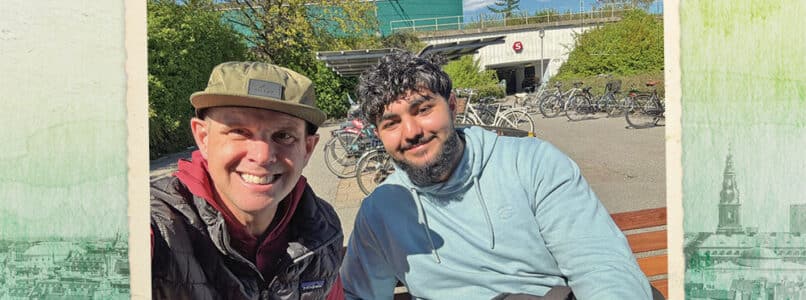
Yousef was waiting for the next train in this Copenhagen suburb on a crisp, sunny day when a group of Americans—Texans, specifically—stepped onto the platform to wait alongside him. 

The 17-year-old is a native Dane, though his parents are Pakistani. He’s a Muslim, but mostly in name only. He doesn’t practice the Salah—a central pillar of Islam requiring prayer five times per day—and he doesn’t go to the mosque often.

Michael Criner, lead pastor of First Rockwall, was among the Texans on the platform that day. Criner, along with a handful of other pastors and church leaders, was in country as part of the Southern Baptists of Texas Convention’s Reach Europe vision tour in early May. 

The purpose of the trip was to introduce SBTC pastors and church leaders to missions opportunities across the continent with the hope of facilitating long-term ministry partnerships. The SBTC, working with the Southern Baptist Convention’s International Mission Board, is targeting seven European cities, including Copenhagen.

Criner struck up a conversation with Yousef, asking about his background and his life in Denmark. He also asked the teenager what he thinks about Jesus.

“Here in Denmark, as a Muslim, I just don’t think about Jesus,” Yousef said.

Even so, Yousef admitted he is curious about Christianity and has watched online videos of Muslims debating Christians. He is also interested in the Trinity and had questions about that. Before their interaction ended, Criner—the first Christian Yousef said he’d ever met—shared the gospel with the teenager.

“Three times, actually,” Criner said later, recounting the conversation.

Ultimately, Yousef did not make a decision to follow Jesus. But …

“You gave me something to think about,” he told Criner. And with that, the two parted ways. 

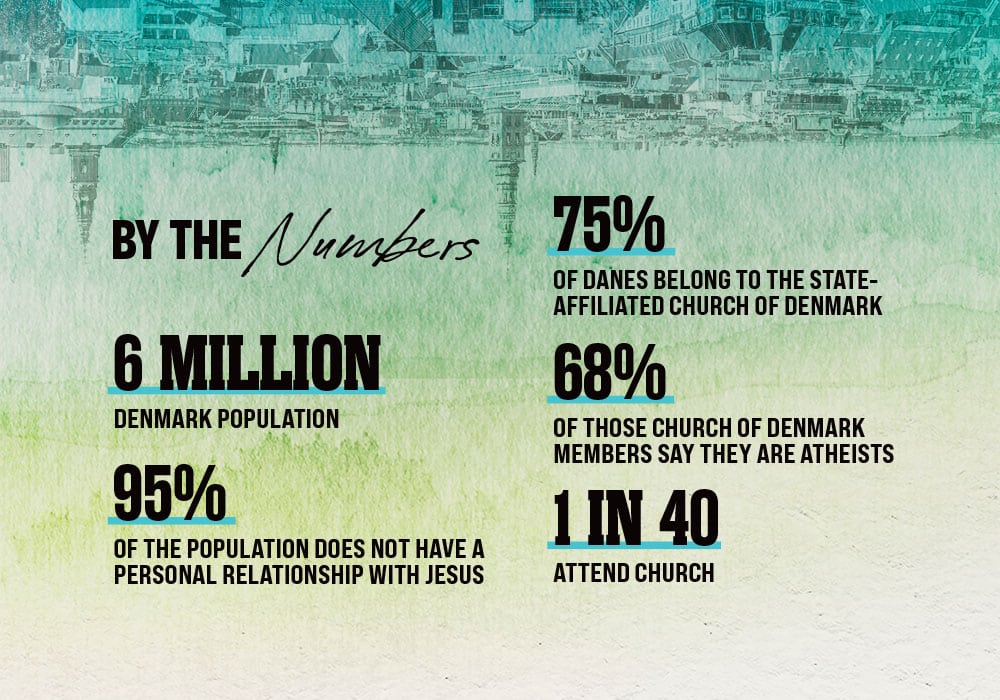
Yousef is among a countless number of Danes who claim a religious identity that exists apart from a practicing faith. For example, the country has a rich Christian history, and yet more than 95%—and likely more—of the country’s 6 million residents do not have a personal relationship with Jesus Christ. About 75% of Danes belong to the state-affiliated Church of Denmark, which performs infant baptisms. Sixty-eight percent of those people, however, say they are atheists. Less than one in 40 attend church.

SBTC churches that partner in Copenhagen will work with IMB personnel in an urban context to serve established Danish churches in revitalization efforts while working alongside missionaries and local believers to engage people with the gospel.

During a debrief with other pastors and leaders near the end of the trip, Criner noted that Copenhagen is a beautiful city and one that might be a smooth entry point for churches because most residents there speak English. He also said SBTC churches that choose to partner in Denmark will find opportunities to encourage the IMB missionaries serving there: Christian Roth, pastor of New Song Church, his wife, Stephanie, and their four children. 

The Roths are the IMB’s only missionary unit on the field in Denmark and Sweden, where Christian was born.

“They are anchored. They are called to Denmark,” Criner said. “They are called to [this region]. They are not going anywhere. If you love pouring into pastors and you’re looking to help plant a church in Denmark and Sweden, this is your team.”

Amid wars and rumors of wars, a promise of comfort

Like many of you, I have been watching closely the events in the Middle East as Israel and the U.S. wage war against Iran. My heart breaks for all those who are suffering in every country. While most Southern Baptists unequivocally support Israel and the U.S., that does not mean we are against people in other countries. I pray for new leadership in countries like Gaza, Iran, and Russia. But there is coming a day when Jesus returns and all wars will cease. No more suffering, invasions, genocides, hunger, etc.  

I love the doctrine of eschatology, which means a study of last things. My great-grandfather, Samuel Isaacs, was an evangelist who lived to be 99 years old. His passion in ministry was the return of Christ and the study of last days. I visited him when I was 17 years old while he was in a nursing home in Oklahoma. He was so passionate about Jesus, and when he began to speak about the Lord’s return, I was thinking the Lord might come back that moment and get him!  

For years I have studied end times prophecy, especially as it is revealed in the book of Revelation. I have preached verse by verse twice through this entire book. There is much mystery regarding the Lord’s return and vigorous debate on important doctrines like the rapture of the church, the great tribulation, and the millennial kingdom. But there is no doubt over the fact Jesus will indeed come back. He promised to do so in John 14:3: “And if I go and prepare a place for you, I will come again and receive you to myself; that where I am, there you may be also.”

"The best thing we can do as followers of Jesus is pray, stay ready, and help as many people as possible come to know Jesus Christ before it is too late."

Scripture teaches repeatedly that Jesus will indeed come back. For example, Acts 1:11 states, “Who also said, ‘Men of Galilee, why do you stand gazing up into heaven? This same Jesus, who was taken up from you into heaven, will so come in like manner as you saw Him go into heaven.’” First Thessalonians 4:16-18 says, “For the Lord Himself will descend from heaven with a shout, with the voice of an archangel, and with the trumpet of God. And the dead in Christ will rise first. Then we who are alive and remain shall be caught up together with them in the clouds to meet the Lord in the air. And thus we shall always be with the Lord. Therefore comfort one another with these words.”

There will be wars and rumors of wars until Jesus comes. The best thing we can do as followers of Jesus is pray, stay ready, and help as many people as possible come to know Jesus Christ before it is too late.

As I approach the end of my time as the president of the Southern Baptists of Texas Convention, it has been a privilege to serve the Lord and our convention. I hope to see you at our annual meeting Oct. 27-28 at Southcrest Baptist Church in Lubbock.

For deep East Texas church, Cooperative Program is as much about going as giving

Calvary Baptist Church made a commitment years ago to tithe on their receipts by giving 10% through the Cooperative Program to support national and international missions and ministries.

“We have kept that [up] through these years,” said Paul Sevar, Calvary’s senior pastor for more than 25 years. 

The church—in a relatively rural area in deep East Texas—has believed in the purpose of the Cooperative Program so much that they “have not missed” what they have given to the kingdom through Southern Baptist work. 

“We very much feel that the Cooperative Program has been a gift to us from God to be able to reach out across our world,” Sevar said. “Whenever you’re able to keep missionaries on the field, it is so important that they don’t have to come home and raise their funds to go back to the mission field.”

Sevar’s wife grew up in a denomination whose missionaries routinely had to leave the field for three or four months at a time to raise support, so that difference in the Cooperative Program is vivid to him. 

“The Cooperative Program is that which keeps our missionaries there to do the work,” he said. 

Children’s ministry at Calvary Baptist Church in Nacogdoches is a key component of training the next generation. SUBMITTED PHOTO

Rarely will someone at Calvary question why so much money needs to leave the church, but Sevar aims to be transparent about why they give. Twice a year, he preaches on missions giving, and church members are invited to talk about it individually if they have questions.

Though in the same town as Stephen F. Austin State University, Calvary has realized through the years that they are “not the college church.” Congregations closer to campus have been more successful at reaching students, and though Calvary has outreaches and some college students attend, the church knows its identity, Sevar said.

Evangelism is a key strategy for reaching the lost in Nacogdoches. Every Monday, church members go into the community to knock on doors. 

“We’re seeing a number of people who are coming to church that used to be in church years ago, and now they’re coming back to church,” Sevar said. “I have to say, it’s because of outreach. It’s because members of the church are out knocking on people’s doors.”

The pastor believes church members knocking on doors, asking to pray for residents, and talking about Jesus is a method the Holy Spirit uses to refresh minds about Christ. “All of a sudden, the Holy Spirit begins to move and convict them,” Sevar said.

Sevar admits times have changed, noting most people would invite him into their homes when he knocked on their doors in the past. More often these days, such invites are not as frequently extended—and some say they don’t even want anyone to pray for them. 

Even so, “if you confront them, the majority of them will listen to you. They won’t all reject you.” Kindness and graciousness go a long way, he said, and often residents will respect people for being bold enough to share their faith. 

“We very much feel that the Cooperative Program has been a gift to us from God to be able to reach out across our world.”

Baptisms at the church can partly be traced to an emphasis on door-to-door evangelism.

With up to 350 attending Calvary on Sundays, they have baptized about 15 people this year. Sevar said the church was baptizing about every other week during one stretch. 

In addition to strong missions giving and evangelism, Calvary goes on mission trips to San Francisco and Belize, where they helped build a church. They are involved in their local Baptist association, a food pantry, and other ministries to advance the kingdom. 

“Calvary has been consistent through the years. We have stayed faithful to not only giving money toward missions, but doing missions,” Sevar said. A long tenure has given him the chance to see the church’s steady impact on its community. 

Methods have had to change, he said, as Sunday night and Wednesday night attendance has dropped in recent years. To compensate, Calvary started weekday Bible studies at times and in groupings that fit busy schedules. The church has anywhere from 80 to 130 people in those studies throughout the week.

Sevar emphasizes the need to continue presenting God’s Word to people and inviting them to follow Jesus. Though church today doesn’t look like it did when he fell in love with it as a boy, it is as critical to God’s mission as ever.

“This church has been such a great, consistent church serving the Lord,” Sevar said, “and we truly believe in the cooperative effort.” 

CP is an impact equalizer

I grew up the son of a Baptist pastor in rural Louisiana. Most of the churches my father pastored were small, but all of them had a big heart for missions. My mother was an active part of that ministry and involved in an organization called the Women’s Missionary Union. This group of ladies kept the church informed about mission efforts around the world. 

As a child growing up in that environment, this was my first exposure to world geography. I heard stories of people and places far away. To my amazement, I was told many of these people in distant lands had never heard about Jesus. 

Of course, I could not remember a time I had not heard of Him, so that seemed impossible. At an early age, we were taught that it is the responsibility of every Christian to share the gospel with the world. But I remember thinking, “How can a small rural church and a child make a difference around the world?” Our church had limited resources, and I was just a kid. 

The answer was the Cooperative Program. By joining hands with thousands of other churches around the world through prayer and giving, small congregations can make a global impact and fulfill the Great Commission. Somehow, even as a child, that made sense. Of course! If we could put our offerings with others, we could get enough to make a difference. 

Today, I am the pastor of a larger church, and the Cooperative Program affords us the exact same opportunity to make a global impact and fulfill the Great Commission. In the small churches I grew up in, missionaries would visit and share stories that captivated our attention and confirmed we were part of what God was doing on the mission field. 

I am privileged today to have many from our church who have answered the call to missions, so for us, the Cooperative Program is very personal. 

Our church partners with many of our missionaries and goes on mission trips around the world on a regular basis to share the gospel. This connection has made a huge difference in our day-to-day ministry. We have become a globally minded church, and that has translated into a desire to reach our neighbor across the street. We often ask our members, “Is your passport current?” That is our way of saying be ready—He may call at any time. 

It is easy to think a larger church can make a global impact in a way a smaller church cannot. Yet because of the Cooperative Program, even churches that do not feel they have a personal connection with missions or are not able to go on a mission trip are just as connected as our church. Here is the genius—if a church gives through the Cooperative Program, each church member has a personal connection to over 3,500 international longterm missionaries and thousands of others serving in North America. This means small and large churches are equal in cooperation as they seek to fulfill the Great Commission. 

The Cooperative Program is not just what we do. It is a part of who we are.

‘All of His creations are beautiful and special’

My husband Jonathan and I came to First Baptist Church in Mansfield in 2018. We both grew up in Fort Worth and had lived in Houston for a time while he finished law school. I worked full time for Child Protective Services for almost nine years, and to me, that was a ministry working with an underserved people group that needs love. It was very important to me. 

We started our family, moving back to Dallas-Fort Worth after law school, and our first daughter, Emilia, was 2 when we joined First Mansfield. I was pregnant with our second daughter, Julianna, when COVID hit. She was born right in the middle of the lockdown, so we attended church from home for a long time just because she was so little. 

Julianna is now 4. She has a genetic disorder called Rett Syndrome. It’s a mutation on the X chromosome and it affects the development of a specific protein in her brain. That protein works with retention of developmental skills. Rett Syndrome is very rare. It’s found in 1 in 15,000 female births. For girls, they have a second X chromosome that allows it to counteract the mutation. When you have a child with Rett, they appear to be developing normally. The syndrome has four stages. Stage one is normal development. Stage two can arise anywhere between 12 months old and 3 years old and is the regression stage. Julianna had words, she could say, “mom,” “dad,” “bunny,” “book.” And then over time she just stopped talking. She was able to use a straw and pick up food with her fingers, the fine motor skills, and then she just didn’t. She was very slow to walk.

You dream of your children going to college and getting married and having children, and that child disappeared. I’m in a better place now because I know it’s not the plan I had for her, but there’s a plan God has for her and it’s going to be beautiful. But I just had to have that moment of the grief of losing the child I thought I would have. And then it affects the future of my older daughter, Emilia. At some point in her life, she will be a caregiver for Julianna. I’m so thankful for Emilia’s tender heart and love for people. That’s really helped me feel comfortable and confident in both of their futures. Emilia already talks now, at 8, of how she’s going to take care of Julianna when we’re not here anymore. And it touches my heart. I tell her that’s a long way away.

Julianna, Jonathan, Lindsey, and Emilia Moss are members of First Baptist Church in Mansfield. SUBMITTED PHOTO

When we started going back in person to First Baptist, we were in the middle of trying to figure out what her delays were. And that’s hard when thinking about telling a nursery volunteer, “Oh, she’s 20 months, but she doesn’t talk.” It was something we didn’t want to have to explain to a different person every time we went on Sundays when we didn’t really have answers. We needed to find a new life group since our former one was gone. We visited all the ones that catered to our stage of life. By that time, we had found out about Julianna’s diagnosis, and we hadn’t really mentioned it to anyone except our pastor, Pastor Spencer [Plumlee], and the preschool minister. In the life group we chose, there were three other families—two that have children with Downs and one that has a different genetic disorder that affects her mobility and bone growth.

I see now that God laid it on our hearts that that’s where we need to be. These are our people. And that was even before First Baptist had a special needs ministry. God was already doing things.

Jonathan and I now lead our life group that has some of those same families in it. A couple of Sundays ago, we were sharing our prayer requests and one of the moms was like, “I just now realized how many of our children have neurological issues.” We are able to support one another because it is such a journey with highs and lows, trying to figure out what’s best for our children when they can’t tell us. So being in the same circumstances with other families provides a camaraderie I guess, being in the same boat as each other and being able to support one another.

Jimmie Gillum is our second special needs minister and she’s done an amazing job growing the ministry. I think she’s brought something special to it, being the parent of an adult special needs child. That’s really going to help grow the ministry at our church even more, instead of just focusing on the young kids. 

We also have the parents’ night out respite nights. I volunteer with them, but I don’t take Julianna since I have extended family who would come watch Julianna any day of the week. I do volunteer because they’re so important. Jimmie’s done some family get-togethers, different events and activities so we can spend time with other special needs families outside of church time, and spending time with volunteers who are giving their time on Sundays during the life group hour and the service hour.

For Julianna, she has a buddy and there’s several, but two or three specific people will go with her. She’s 4, so she’s in the special needs classroom, but then she goes to the fours class and her buddy goes with her. She’s able to be around children her own age and then go back to the special needs classroom if she’s not feeling it. If she is, she stays the whole time and then comes back and we pick her up from there. 

My favorite verse is Lamentations 3:22-23: “Your mercies are new every morning.” Every day that I wake up and I see Julianna learning new things or developing new skills, it’s just a reminder that God’s not done, and she cannot be limited by a diagnosis. I’m thankful I have that outlook. Psalm 146:6 talks about God creating the heavens. Julianna doesn’t calm down like a normal child, and cuddling or holding doesn’t work either. Right after she’d been diagnosed, we had a screensaver on our TV that was constellations and galaxies, and I could put those pictures on and she would stop crying. We now have a starlight that shines up on her ceiling and it just brings her such peace. I was very thankful that Scripture can remind us that God is in control of all things. All of His creations are beautiful and special.

Jesus is Writing My Story logo

Want to share a story of what God is doing in your life or your church? 

Share your story here

West Texas church sets goal to have 145,000 gospel conversations over the next 8 years

At a time when many seem to move further away from the church, Glen Meadows Baptist Church is seeing people come closer.

“Two years ago, we were averaging 100 more each Sunday than the year before,” Senior Pastor Mack Roller said. “Since October, we’ve baptized 46, and that almost matches what we did last year all year.”

Rugged individualism is pervasive in West Texas, Roller said, and drug use is rampant. San Angelo’s suicide rate surpasses the national average and people here often feel isolated, so Glen Meadows is training its members to break down barriers.

“One of the attributes of a dream disciple at Glen Meadows is a faithful friend,” Luke Roller, pastor of discipleship ministries, said. “We try to equip them with conversation pieces and how to navigate a conversation from the day-to-day into a spiritual conversation, into a gospel presentation.”

In communication efforts leading up to Easter, for instance, Glen Meadows, with an average attendance of 1,200, placed an emphasis on equipping people to invite. The church distributed digital invitation cards that people could text or email to their friends, and QR codes and T-shirts directed people to the church’s Easter page. 

“That resulted in our highest-attended Easter Sunday that we’ve had in the history of Glen Meadows,” Luke Roller said. 

“Two years ago, we were averaging 100 more each Sunday than the year before. Since October, we’ve baptized 46, and that almost matches what we did last year all year.”

Three or four years ago, church leadership was burdened to increase their prayer efforts, the pastor said. Since then, the staff has spent more time in prayer, small groups have extended prayer times, deacons pray more at their meetings, and the congregation has prayer nights.

“I think this is a crucial point, and I think it has brought a lot of peace,” Mack Roller said. “The main thing is it took our eyes off ourselves and what church can do for us and put our eyes on the Lord and what He wants from us.”

Not long after the renewed prayer emphasis, God led Mack Roller to be involved in some of the initial Regenesis training centered on church health and revitalization offered by the Southern Baptists of Texas Convention. Implementing some of those elements, the church reworked its vision and broke it up into chronological goals. A notable goal that emerged from that process is for the church to have 145,000 gospel conversations in eight years, “which is kind of miraculous,” he said. 

“It’s a big one,” he added, “but with a calculator, we can do it if we just stay focused.”

The goal includes seeing 500 disciple-makers impacting the lives of 2,000 people. “It sounds impossible, but actually it’s not,” Mack Roller said. Once the large number of 145,000 is broken down into what each person can do, it’s manageable.

“In the breaking down, someone might say, ‘That’s the role that I can play.’ It gives people handles to hold onto to own it,” Luke Roller said.

“Right now, our foyer is really small and it’s hard to even meet people. We’re adding a lot of space for people to mingle and build relationships.”

Glen Meadows kicked off the 145,000 goal in January, and now they have an app to log gospel conversations. If, for example, a church member has a gospel conversation at a local restaurant, he might take a picture of the table or the sign, upload it, and ask people to pray for that conversation to bear fruit.

The vision process yielded five values Glen Meadows seeks to connect with everything it does:

  • We dig deep because living water is worth the work.
  • We make room because the gospel creates space for everyone at the table. 
  • We kneel down because we can’t wash feet while standing up.
  • We team up because Jesus calls us out of isolation into participation. 
  • We have fun because joy is the culture of heaven. 

Pertaining to making room, Glen Meadows introduced a building campaign for a second campus across the street to include an auditorium with 1,600 seats, a children’s department, adult education space, and a large common area.

“Right now, our foyer is really small and it’s hard to even meet people,” Mack Roller said. “We’re adding a lot of space for people to mingle and build relationships.”

The church hopes to break ground by the end of the year, and already leadership is encouraged by the response. 

“We did a capital campaign last October,” Mack Roller said. “We wanted 100% of our active givers to participate. We ended up with 134%. It was very positive. There was just a lot of unity.”

Luke Roller added, “We’re not trying to solve a problem that doesn’t exist. The problem is felt every single Sunday by our people.”

Meanwhile, church members keep inviting those in their spheres of influence looking for answers and purpose. If Glen Meadows has its way, it will have the opportunity to provide that answer—the gospel—145,000 times.